9/10Watch

Dragon Ball Z Episode 120 Review
“Frieza Halved by a Single Blow!! Another Super Saiyan!”
Frieza has returned. After the enormous, planet-destroying struggle on Namek, the former emperor of the universe arrives on Earth rebuilt with cybernetic parts and accompanied by his father, King Cold. He has survived the impossible, become even stronger, and travelled directly to Goku’s homeworld to take revenge.Under normal circumstances, that would be enough material for another prolonged crisis. The heroes would gather. Vegeta would posture. Frieza would threaten the planet. Goku would arrive at the final possible second.
Instead, a teenage boy in a denim jacket walks into the desert carrying a sword.
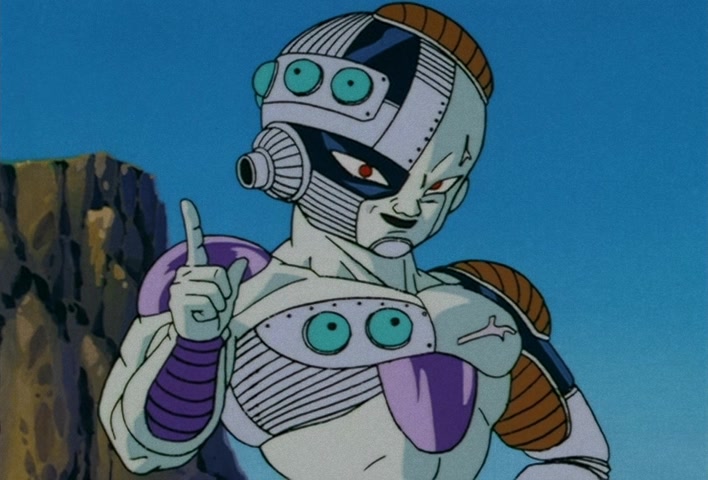
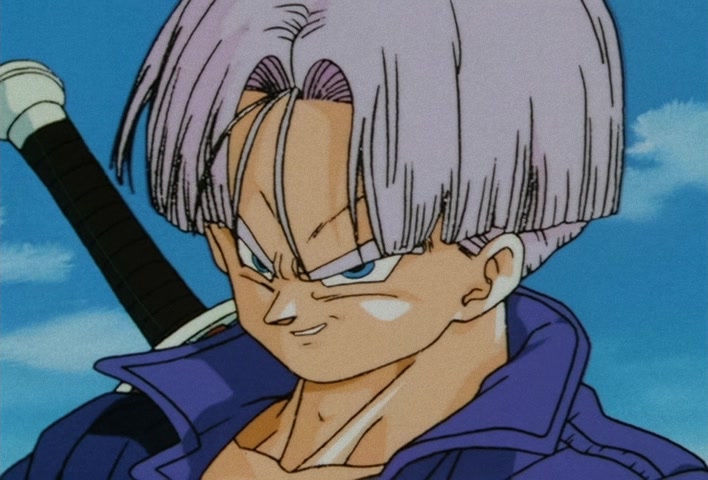
That image is the foundation of the entire episode. The stranger does not look physically imposing, and he makes no grand entrance. He simply appears, calmly explains that he knows why Frieza has come to Earth, and begins dismantling the soldiers surrounding him. He offers no name, no history and no explanation for how he knows any of this. The episode understands that withholding information can be far more exciting than immediately delivering it. Every new thing the boy does creates another question. Why is he waiting for Frieza? How does he know about Goku? Why is he carrying a sword in a world where the strongest fighters can destroy mountains with their hands?
Then he reveals the detail that changes everything: Goku is not the only Super Saiyan.
The transformation is shocking not merely because another Super Saiyan exists, but because of how casually the episode presents it. Goku’s transformation on Namek was the emotional climax of an enormous tragedy. It required Krillin’s death, Goku’s rage and the apparent fulfilment of an ancient legend. This stranger simply announces what he is and transforms.
For the audience, it is a revelation. For Vegeta, watching from a distance, it is practically a personal attack. Vegeta spent the Namek saga consumed by the legend of the Super Saiyan. He believed the form belonged to him by birthright, only to discover that Goku had achieved it first. Now an unknown teenager has arrived and accessed the same legendary power as though it were the most natural thing in the world.
His reaction is one of the episode’s best character moments. He does not know who this boy is, but he already resents him. The stranger’s existence challenges everything Vegeta believes about his heritage, his destiny and his position among the surviving Saiyans.
Frieza’s response is equally revealing. The tyrant who once treated entire civilizations as disposable immediately recognizes the golden hair and green eyes that haunted his final moments on Namek. His confidence disappears almost instantly. He survived one Super Saiyan. He has no desire to face another.
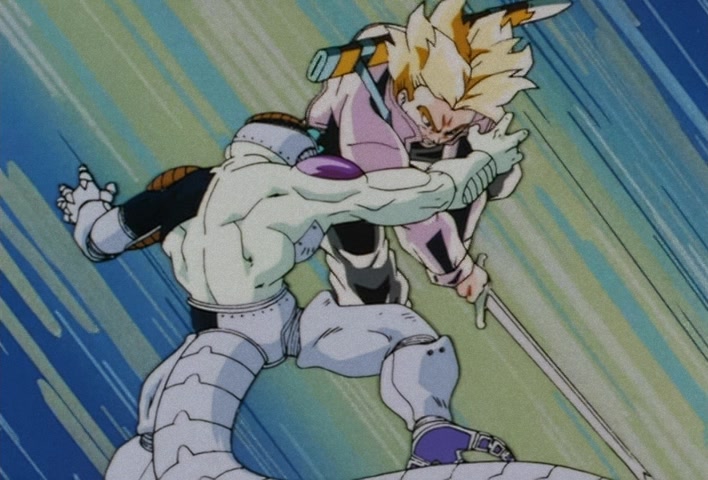
That panic gives the episode its real dramatic power. Frieza attempts to regain control through spectacle, launching an enormous sphere of energy at the stranger. It is exactly the kind of attack that once made him seem untouchable. The boy catches it. Frieza adds more power. The boy continues holding it. Then, after allowing Frieza to believe the attack has succeeded, he reappears above him with his sword drawn.
The episode ends at the precise moment the blade passes through Frieza. No aftermath. No explanation. No identity reveal. Just the image of the universe’s former ultimate villain being cut apart by someone the audience has never seen before.
It is one of the greatest cliff-hangers in the series.
Modern viewers are unlikely to experience the scene as its original audience did. Trunks is now one of the franchise’s most recognizable characters. His parentage, his time machine and his warning about the future have been printed on home-video packaging, discussed in games and repeated across decades of promotional material. But when this episode originally aired, viewers did not yet know any of that.
For one week, this boy was simply an impossible mystery: a second Super Saiyan who knew Goku, carried a sword and appeared to understand events before they occurred. The next episode would begin answering those questions, but Episode 120 is powerful precisely because it refuses to answer them itself. That restraint gives the story an atmosphere that is difficult to recreate once the secret is known.
The episode also performs an essential piece of narrative housekeeping. Frieza had been the central threat of the longest and most destructive conflict in the series. Bringing him back immediately creates the expectation of another major confrontation. Having the stranger defeat him so quickly is not simply a display of strength. It tells the audience that the Frieza saga is definitively over.
The standards have changed.
A villain who once required an extended planetary war can now be eliminated in moments. The new character is dangerous, the next threat must be even worse, and the series is entering unfamiliar territory. That is escalation handled properly. Instead of merely announcing that stronger enemies are coming, the episode demonstrates it by reducing the previous ultimate villain to a measuring stick.
The production helps sell that transition. Under Katsuyoshi Nakatsuru’s animation supervision, the characters remain clean and expressive, while the action has a deliberate sense of weight. The stranger does not win through frantic movement or an endless exchange of attacks. His confidence is communicated through stillness. He waits. He watches. He lets Frieza attack first. When he finally moves, the confrontation is already over.
The anime does add material around the encounter, including additional soldiers for the mysterious swordsman to dispatch. It is padding in the strict adaptation sense, but it is unusually effective padding. The soldiers provide a gradual demonstration of his ability before he confronts Frieza himself. More importantly, they allow the mystery to breathe. The sequence becomes a controlled escalation: first the soldiers, then the transformation, then the energy attack, and finally the sword.
The pacing is somewhat unusual. The Super Saiyan reveal occurs relatively early, while the episode reserves the actual strike against Frieza for its final image. That creates a back-heavy structure in which much of the runtime is spent delaying an outcome that increasingly feels inevitable. In another episode, that could become frustrating. Here, the delay is the point.
Frieza keeps escalating because he cannot accept what is standing in front of him. The stranger keeps allowing him to try because he has no reason to feel threatened. Each failed attack strips away another piece of Frieza’s authority until the sword strike feels less like the conclusion of a battle and more like a sentence being carried out.
The contrast with the Namek battle is enormous. Goku defeated Frieza after an exhausting struggle filled with rage, grief and destruction. This boy defeats him with near-total emotional control. That difference tells us something important before we know anything else about him. He may possess the power of a Super Saiyan, but he is not another version of Goku. His clothes, weapon, mannerisms and controlled aggression all suggest a life and background completely removed from the characters we already know.
That distinct identity is why the mystery works so well. The episode is not merely asking, “Who is this stronger fighter?” It is asking how someone like him can possibly exist within the world the series has established.
There are small continuity oddities if the sequence is examined too literally, particularly in how quickly certain characters recognize and understand the transformation. Yet the emotional logic is so strong that these details barely matter. Vegeta sees another Super Saiyan and reacts exactly as Vegeta should. Frieza sees the form responsible for his humiliation and immediately loses his composure. The character truth overwhelms the technical quibble.
Later edits and condensed versions of the story may move through this material more efficiently, but efficiency is not necessarily the same thing as impact. The original episode gives the confrontation an entire broadcast slot, allowing the unknown warrior to dominate the screen before the story begins explaining him.
That isolation matters. Episode 120 is not yet the story of Trunks, Vegeta’s son from the future. It is the story of a stranger arriving from nowhere and effortlessly destroying the villain who once seemed impossible to defeat. For twenty minutes, the mystery is allowed to remain a mystery.
That is what makes the episode legendary.
Verdict
Episode 120 is Dragon Ball Z operating with complete confidence. It reintroduces one of the series’ greatest villains, places him opposite a completely unknown teenager, and then lets that teenager dismantle both Frieza and the audience’s understanding of the series.The episode’s pacing is not perfectly balanced, and the wait between the transformation and the final strike is longer than necessary. But the extended build also gives the confrontation its extraordinary tension. Every scene reinforces the same idea: Frieza believes he has returned as the greatest power in the universe, yet the story has already moved beyond him.
Nakatsuru’s animation supervision gives the episode visual consistency and weight. Vegeta’s reaction adds sharp character comedy and wounded pride. Frieza’s panic transforms an almost invincible tyrant into a terrified survivor. Above all, the decision to withhold the stranger’s identity creates one of the most effective introductions in shonen anime.
A nameless swordsman appears. Another Super Saiyan is born. Frieza raises his hand to fight, and the episode cuts him down before it gives us a single answer.
Rating: 9/10
Reviewing
Dragon Ball Z
View anime detail →
