
7/10Flawed Gem

Samurai 7 Episode 17 Review
Samurai 7 spends sixteen episodes gathering seven warriors to save one village. Then one of them dies, and the village goes back to work.That is the uncomfortable beauty of "The Remembrance." The Nobuseri are beaten. Kambei has handed the rebuilding of the burned village to Shichiroji and walked off alone. Kyuzo has vanished. Gorobei is in the ground. The rice is ready, so the farmers do what farmers do and harvest it. For Kanna, this is what victory looks like. For Kikuchiyo and Katsushiro, it feels like being left behind.
The rice survived. Gorobei didn't. The world isn't stopping long enough to notice the difference.


The harvest doesn't wait
Shichiroji checks with old Gisaku that the fields are ready, and the whole village heads out with sickles. Kikuchiyo goes with them. The giant mechanical samurai who has spent half the series punching through Nobuseri armor turns out to be hopeless with a stalk of rice, and Komachi and Okara laugh at him the whole time. 😛The joke has teeth. Kikuchiyo was born a farmer. He fought for Kanna as hard as anyone because he knows what it means to be powerless when armed men come for the harvest. He traded his body for a machine to become a warrior, and now that the fighting is over he can't do the work he was born to. He doesn't fit the world he came from, and he still isn't sure he fits the one he paid to join. That is a far better problem than whether a robot can swing a sickle.
Gorobei's grave and the price of victory
Kikuchiyo ends up at Gorobei's grave carrying a resentment he has nowhere to put. He mutters that Gorobei may have died for nothing, and he's angry that Kambei walked off and left them behind.It's a hard thing to say after "The Storm." Gorobei was the most naturally gifted of the seven, a street entertainer who caught arrows out of the air for coin and turned danger into a performance. His confidence gave the others something to lean on. He died standing in front of Nobuseri gunfire so a village of farmers could keep living. Kanna is standing. The farmers are alive. The rice is coming in. Kikuchiyo knows all of it.
Knowing why someone died doesn't make the empty space any smaller.
Heihachi is the one who answers him. He tells Kikuchiyo that dying there was Gorobei's own decision, and that Kambei will come back. When Kikuchiyo asks what a samurai is supposed to look like, Heihachi tells him to look in a mirror. It's the best line in the episode. Kikuchiyo has spent the entire series begging the warrior class for recognition, waiting for Kambei to call him a real samurai, trying to prove he belongs beside men who have carried swords their whole lives. Heihachi, the engineer who would rather fix a machine than kill anyone, hands him the answer he keeps missing. Kikuchiyo chose to protect people. That is the proof.
Katsushiro and the romance of war
Katsushiro wanted to be a samurai before he knew what it cost. In "The Master" he looked at Kambei and saw everything he hoped to become: discipline, experience, and the kind of respect nobody has to ask for. Since then he has fought, killed a man with his own hands, and watched one of the seven die. Now his teacher has left without him.Kirara finds him sitting alone with all of it and walks him through how the Great War happened. The whole series sits underneath that conversation. Samurai rebuilt their bodies into fighting machines to win a war, the merchants ended it, and a lot of those converted warriors became the Nobuseri, still armed and with nothing left to fight for except the next village's rice.
What happens to people who spent their whole lives preparing for war when nobody needs them to fight anymore?
The Nobuseri are one answer. Katsushiro is walking toward that question just as Kikuchiyo is walking away from it. By the end of the scene Katsushiro understands something Kyuzo told him about wanting to live, and for the first time he isn't following Kambei because the older man looks impressive. He's starting to own what his choices are turning him into.
The episode remembers too much
Here is my problem with Episode 17. It spends a lot of time remembering for an episode with real new things to say.Katsushiro and Kikuchiyo both drift back through the recruitment journey and the people they met on the way to Kanna. Some of it works. Remembering Gorobei after his death is natural, and going back to the beginning shows how far the group has come. But Gonzo also uses the aftermath as cover for a recap of the first sixteen episodes, and grief and a recap are different things. The emotional material is strong enough without the replays. Kikuchiyo at a grave is more interesting than another reminder of how everyone met.
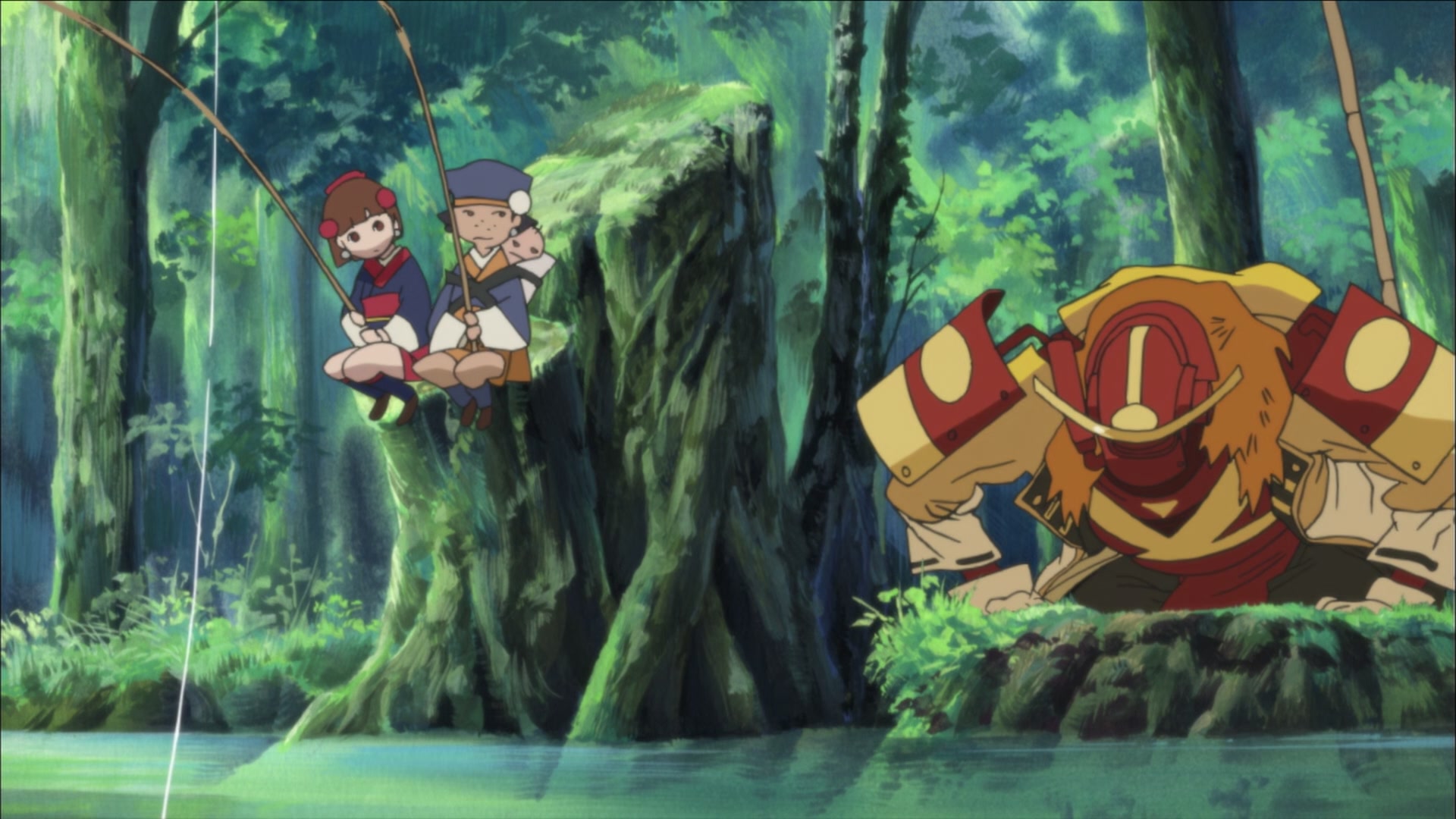
The English title is honest about this. The Japanese title points somewhere better. Karu! means "Reap!", and the best scenes are the reaping: the fields, the grave, Kikuchiyo staring at his own reflection in the river while the kids fish beside him. For a series about people working out who they are after a war, Episode 17 is strangely reluctant to leave its own past behind. It's a worthwhile pause. I wish it trusted the quiet more.
The war isn't finished
Outside Kanna the story is already moving. The women the Nobuseri took, Rikichi's wife Sanae among them, were carried off to the Capital before the battle ended. Word of the Nobuseri's defeat reaches Ukyo, and a messenger from the Emperor brings him a promotion. His father Ayamaro is stripped of the Magistrate's post for failing to catch the samurai, and Ukyo takes the seat. He sets out for the Capital to pay his respects, and respect is not what he's planning.Kambei, meanwhile, walks alone to the Guardians' cave. Honoka runs to meet him. He tells her Gorobei is dead and Kanna is saved, and that he has come to keep his promise and bring her sister home. Her masters will take him to the Capital. Then the Guardians drop down around him.
Back at Kanna, Kikuchiyo stops sulking and works out what he has to do. He finds Katsushiro and Kirara tending the wounded Rikichi and tells Katsushiro they're going after Kambei. Katsushiro hesitates, since Kambei told them to stay put. Kikuchiyo shames him out of it by asking what kind of samurai sits and waits.
That's the change in scale the back half of the series runs on. The samurai were hired to defend a rice harvest: seven swords in exchange for food. That contract is done. But the Nobuseri were only the visible end of a system that feeds on villages, and beating one bandit force doesn't touch the people who sent it. Kambei already knows. Now the others have to decide whether being a samurai means honoring a finished contract or going after the people who can't fight back.
Kanna's battle is over. The reasons for fighting aren't.
Kurosawa, Gonzo and the farmers who win
Akira Kurosawa's Seven Samurai opened in 1954. Fifty years later, Gonzo rebuilt its premise with mechanized warriors, bandit warships, glittering sky cities, and digital animation ambitious enough that Animax premiered it as an exclusive high-definition pay-per-view broadcast. Director Toshifumi Takizawa's 26 episodes ask what Kurosawa's conflict looks like in a world where war has rebuilt human bodies.Under all that machinery, the series keeps Kurosawa's sharpest observation. At the end of the film, Kambei looks at the graves and says it plainly: the farmers won, not the samurai. Farmers plant, harvest, and rebuild. Their future runs past the battlefield. The samurai are only needed because that future is threatened.
Episode 17 drops us back into the paddies after a battle full of explosions and giant machines, and it becomes obvious how little the basic story has changed. Gorobei didn't die to earn a monument. He died so ordinary people could have ordinary lives.
Sometimes the most uncomfortable proof that a sacrifice mattered is watching everyone else go back to normal.
From fansubs to Funimation
Samurai 7 arrived during one of the busiest stretches of English digital fansubbing. Our Western Release & Fansub History page documents six groups or release identities attached to Episode 1, including a confirmed joint project between Anime-Keep and ANBU. Their original June 15, 2004 announcement reminded fans that Samurai 7 aired biweekly, so a week without a release wasn't a delay. That detail captures the era perfectly: fans watching the Animax calendar and following whichever group could get the next pair of episodes to them first. Anime-Kraze also worked the series and later listed the project as dropped after Episode 15, a reminder that the version you started downloading wasn't always the version you finished.Funimation licensed the series for North America. Episode 17 reached DVD on Volume 5, Empire in Flux, on March 28, 2006, almost four months before IFC aired it. The dub also ran in high definition on Voom's Animania HD, and a new audience found the show when Toonami picked it up in August 2012. A futuristic remake of a Japanese film classic reached the West through fansubs, DVDs, and three different television runs.
Twenty-two years later, the best part of Episode 17 still isn't the machinery. It's a farmer in a metal body standing beside a grave, asking whether the man buried there died for something worthwhile.
Why it matters
"The Remembrance" is not Samurai 7 at its most exciting. It leans too hard on recycled footage, and anyone expecting another spectacular fight after Episode 16 will find it a frustrating detour.I wouldn't dismiss it. Kikuchiyo's struggle with who he is, Katsushiro's changing understanding of violence, and the farmers bringing in their rice all push the show's central question further than another battle could. What is a samurai supposed to protect? A village, a harvest, a promise, or the people who can't defend themselves? And what happens when that protection costs someone his life?
The episode answers in the fields. The villagers are harvesting because Gorobei and the others gave them the chance.
The tragedy is that Gorobei doesn't get to share in the peace he helped create.
That's what makes Episode 17 worth remembering, even when it spends too long reminding us of what came before.

Reviewing
Samurai 7
View anime detail →
~ edited Nov 5, 2026
