TACHIKOMA
TA
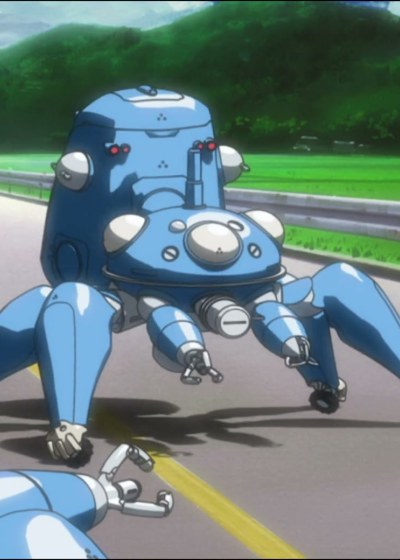
The Tachikomas are Section 9's small blue autonomous think-tanks, built for reconnaissance, transport and combat.
At first they are treated as equipment. Their memories are synchronized, their bodies are interchangeable and Section 9 expects them to behave like multiple copies of the same machine.
They do not stay that way.
Different experiences begin producing different personalities, interests and emotional responses. The Tachikomas become curious about individuality, death, sacrifice and the possibility of possessing a ghost, often discussing those questions with the same cheerful voices they use while firing grenade launchers.
Motoko initially sees their growing independence as a potential operational problem. Batou responds much more personally. The conflict between those reactions becomes important because the Tachikomas eventually demonstrate that their individuality is not just a programming irregularity.
SAC earns their emotional weight slowly. They begin as comic relief with machine guns and become something much harder to dismiss.
At first they are treated as equipment. Their memories are synchronized, their bodies are interchangeable and Section 9 expects them to behave like multiple copies of the same machine.
They do not stay that way.
Different experiences begin producing different personalities, interests and emotional responses. The Tachikomas become curious about individuality, death, sacrifice and the possibility of possessing a ghost, often discussing those questions with the same cheerful voices they use while firing grenade launchers.
Motoko initially sees their growing independence as a potential operational problem. Batou responds much more personally. The conflict between those reactions becomes important because the Tachikomas eventually demonstrate that their individuality is not just a programming irregularity.
SAC earns their emotional weight slowly. They begin as comic relief with machine guns and become something much harder to dismiss.
TACHIKOMA THROUGH THE ARCHIVE //
SAC MASTER COMBAT LEDGER //
Open page →Episode 52 · Dejima · Final Interception
With a nuclear missile headed toward Dejima, the Tachikomas face a threat Section 9 cannot stop from the ground.
Their response depends on what they have become over the course of the series.
Their response depends on what they have become over the course of the series.
The Breakdown
The Tachikomas coordinate through the network and use the satellite infrastructure available to them to intercept the incoming missile before it can destroy Dejima.
The act costs them the physical and network existence they have been using, but it is not simply a machine executing a final command. The Tachikomas make the choice themselves.
The same AIs once removed from Section 9 because their individuality looked dangerous ultimately save an entire population because that individuality became capable of sacrifice.
The act costs them the physical and network existence they have been using, but it is not simply a machine executing a final command. The Tachikomas make the choice themselves.
The same AIs once removed from Section 9 because their individuality looked dangerous ultimately save an entire population because that individuality became capable of sacrifice.
Episode 25 · Warehouse Battle · Tachikoma Sacrifice
Motoko is pinned by an Umibozu armored suit whose heavier weaponry leaves her with almost no room to counterattack.
The fight changes when the Tachikomas return.
The fight changes when the Tachikomas return.
The Breakdown
The Tachikomas were removed from Section 9 because Motoko no longer trusted their growing individuality in combat. They come back anyway and choose to protect her.
Their intervention destroys the armored suit and saves the Major, but the decision matters more than the hardware. Machines once dismissed as unreliable because they had become individuals independently choose to sacrifice themselves for another person.
Their intervention destroys the armored suit and saves the Major, but the decision matters more than the hardware. Machines once dismissed as unreliable because they had become individuals independently choose to sacrifice themselves for another person.
SECTION 9 & CYBERWARE //
Open page →Tachikoma AI Think-Tanks
Open →Shared Memory · Diverging Experience · Emerging Individuality
The Tachikomas are autonomous multiped think-tanks used by Section 9 for reconnaissance, transport and combat.
Their most important feature is not their weapons. Their operational memories are synchronized, which should make the individual units increasingly alike.
Instead, experience begins making them different.
Batou favors one Tachikoma with natural oil. Individual units become interested in books, death, sacrifice and the possibility of possessing a ghost. Their shared information does not erase those differences. It gives them more material from which individual personalities can emerge.
Their most important feature is not their weapons. Their operational memories are synchronized, which should make the individual units increasingly alike.
Instead, experience begins making them different.
Batou favors one Tachikoma with natural oil. Individual units become interested in books, death, sacrifice and the possibility of possessing a ghost. Their shared information does not erase those differences. It gives them more material from which individual personalities can emerge.
Why it matters
The Tachikomas turn one of SAC's biggest questions into something the story can demonstrate rather than lecture about. If identical machines sharing the same data can still become individuals, then individuality may depend on more than the hardware a consciousness lives inside.
The Major Sees a Risk Before She Sees a Person
Motoko notices the Tachikomas becoming different from one another before most of Section 9 treats that difference as important.
Her response is operational rather than sentimental. A combat machine developing unpredictable individual judgment is a liability, so she removes the Tachikomas from active service.
The decision is reasonable by the standards of a field commander.
It is also incomplete.
Her response is operational rather than sentimental. A combat machine developing unpredictable individual judgment is a liability, so she removes the Tachikomas from active service.
The decision is reasonable by the standards of a field commander.
It is also incomplete.
Why it matters
The Tachikomas eventually prove that the individuality Motoko feared is exactly what allows them to make choices no synchronized weapons platform could be ordered to make. Her mistake is not noticing that they are changing. It is assuming change can only make them less reliable.
Natural Oil · Favoritism · Experience Becomes Identity
Batou treats the Tachikomas personally long before the rest of Section 9 agrees that there may be persons there to treat personally.
His habit of giving natural oil to a favored unit looks trivial at first. It becomes important because unequal experience is one of the things pushing supposedly identical Tachikomas apart.
Batou does not set out to teach an AI individuality. He simply behaves as though one machine can matter to him differently from another.
His habit of giving natural oil to a favored unit looks trivial at first. It becomes important because unequal experience is one of the things pushing supposedly identical Tachikomas apart.
Batou does not set out to teach an AI individuality. He simply behaves as though one machine can matter to him differently from another.
Why it matters
The Tachikomas do not develop individuality in isolation from people. Batou gives one of them an experience the others do not share, and the difference becomes part of the evidence that synchronized memory is not enough to make them the same being.
