
THE LAUGHING MAN SPOILER!
TL
The figure remembered as the Laughing Man begins with Aoi, a gifted young hacker who abducts Serano Genomics president Ernest Serano after discovering information about the suppressed Murai vaccine.
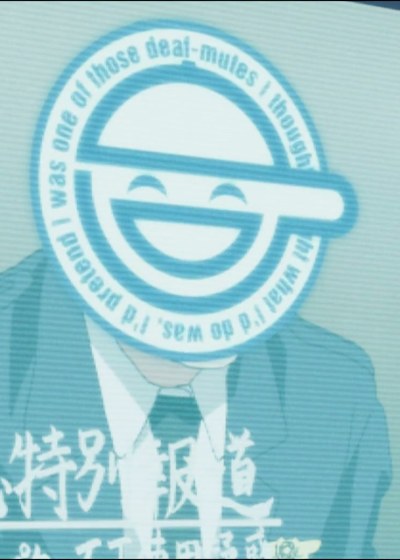
During the televised hostage incident Aoi hides his face in real time behind the now-famous Laughing Man logo. The image spreads far beyond him.
That distinction becomes the heart of the first season. Many later crimes, threats and public appearances attributed to the Laughing Man are copies, appropriations or events people connect together after the fact. Aoi himself never set out to build the vast conspiracy that grows around the name.
By the time Section 9 reaches him, the Laughing Man is no longer simply one hacker.
WHY HE MATTERS:
Aoi is the original actor inside a phenomenon that becomes larger than its origin. The case eventually gives Section 9 the clearest example of the process the series calls a Stand Alone Complex.
During the televised hostage incident Aoi hides his face in real time behind the now-famous Laughing Man logo. The image spreads far beyond him.
That distinction becomes the heart of the first season. Many later crimes, threats and public appearances attributed to the Laughing Man are copies, appropriations or events people connect together after the fact. Aoi himself never set out to build the vast conspiracy that grows around the name.
By the time Section 9 reaches him, the Laughing Man is no longer simply one hacker.
WHY HE MATTERS:
Aoi is the original actor inside a phenomenon that becomes larger than its origin. The case eventually gives Section 9 the clearest example of the process the series calls a Stand Alone Complex.
THE THROUGH THE ARCHIVE //
LAUGHING MAN & COMPLEX //
Open page →The Concept of a Stand Alone Complex
Open →Independent Copies · A Pattern Larger Than Its Origin
A Stand Alone Complex occurs when separate people independently imitate, extend or respond to a behavior until the accumulated copies create the appearance of one coordinated phenomenon.
The Laughing Man case makes the idea deliberately paradoxical because Aoi really did commit an original act. He kidnapped Ernest Serano and created the image that became associated with the Laughing Man.
But the public Laughing Man phenomenon does not remain identical to Aoi.
Other people copy the symbol. Criminals use the name. Institutions manipulate the story. Observers connect unrelated acts into one narrative. Eventually the thing society calls the Laughing Man becomes something no single Laughing Man created.
The Laughing Man case makes the idea deliberately paradoxical because Aoi really did commit an original act. He kidnapped Ernest Serano and created the image that became associated with the Laughing Man.
But the public Laughing Man phenomenon does not remain identical to Aoi.
Other people copy the symbol. Criminals use the name. Institutions manipulate the story. Observers connect unrelated acts into one narrative. Eventually the thing society calls the Laughing Man becomes something no single Laughing Man created.
Why it matters
The copy without an original does not mean nothing happened first. It means the copied phenomenon becomes so much larger than its starting point that searching for one mastermind can no longer explain it.
Aoi · Ernest Serano · The Original Incident
In 2024, Aoi abducted Serano Genomics president Ernest Serano and confronted him over the suppressed treatment for cyberbrain sclerosis.
The confrontation became famous because Aoi concealed his face even during live coverage. He manipulated the visual information seen by cyberized witnesses and cameras, replacing himself with the smiling Laughing Man logo.
The technical feat made him legendary, but the reason for the kidnapping mattered more. Aoi had discovered evidence that an effective treatment had been buried while powerful interests benefited from alternatives.
The confrontation became famous because Aoi concealed his face even during live coverage. He manipulated the visual information seen by cyberized witnesses and cameras, replacing himself with the smiling Laughing Man logo.
The technical feat made him legendary, but the reason for the kidnapping mattered more. Aoi had discovered evidence that an effective treatment had been buried while powerful interests benefited from alternatives.
What changed
The Serano incident gave later copycats a face, a name and a public grievance they could reuse. Aoi created the original event. Society created most of what came afterward.
Suppressed Medicine · Corporate and Political Interests
Cyberbrain sclerosis is a serious disease affecting people with cyberbrains. Dr. Murai developed an effective treatment, but approval and public recognition of that treatment were suppressed.
The cover-up benefited people and organizations connected to competing micromachine treatments and the political structure surrounding their approval.
Aoi discovered the hidden Murai research and traced the scandal toward Serano Genomics, which is why the original Laughing Man incident begins with Ernest Serano rather than with a random act of cyber-terrorism.
The cover-up benefited people and organizations connected to competing micromachine treatments and the political structure surrounding their approval.
Aoi discovered the hidden Murai research and traced the scandal toward Serano Genomics, which is why the original Laughing Man incident begins with Ernest Serano rather than with a random act of cyber-terrorism.
Why it matters
The Laughing Man case begins with a real crime hidden beneath the spectacle. The logo becomes famous enough to obscure the fact that Aoi originally acted because people with power had buried a treatment that could save lives.
Memory, Vision & Cyberbrain Evidence
Open →When Witness Testimony Can Be Hacked
Cyberbrains let people communicate with networks directly, but the same connection creates forms of evidence manipulation that ordinary policing was never designed to handle.
A sufficiently skilled hacker can alter what a cyberized person sees, interfere with memories, impersonate another presence or manipulate network records around an event.
Aoi's face-hiding technique is the most famous example, but the larger problem follows Section 9 throughout the case: seeing something is no longer proof that the information reached your brain unchanged.
A sufficiently skilled hacker can alter what a cyberized person sees, interfere with memories, impersonate another presence or manipulate network records around an event.
Aoi's face-hiding technique is the most famous example, but the larger problem follows Section 9 throughout the case: seeing something is no longer proof that the information reached your brain unchanged.
Why it matters
The Laughing Man investigation is difficult because the team cannot automatically trust cameras, memories or network records. Section 9 has to investigate the manipulation of evidence at the same time it investigates the crime itself.
Episode 6 · Independent Attackers · One Shared Identity
The assassination attempt surrounding Superintendent-General Daido creates one of the clearest demonstrations of the Stand Alone Complex.
Multiple attackers appear to be acting as the Laughing Man, yet the investigation cannot find the central coordination that should connect them.
The symbol has become enough.
Different people can attach their own anger, motives and plans to the same public identity without receiving orders from the person who created it.
Multiple attackers appear to be acting as the Laughing Man, yet the investigation cannot find the central coordination that should connect them.
The symbol has become enough.
Different people can attach their own anger, motives and plans to the same public identity without receiving orders from the person who created it.
Why it matters
The case stops being a hunt for one super-hacker and becomes a problem of social replication. Section 9 cannot solve the Laughing Man merely by identifying the first person who used the name.
The Original Laughing Man Did Not Control the Myth
Aoi committed the original Serano kidnapping, but that does not make him the author of everything later attributed to the Laughing Man.
Once the logo and story entered public consciousness, copycats, criminals, political actors and the media repeatedly reused the identity for their own purposes.
Aoi eventually becomes almost incidental to the public version of the thing named after him.
Once the logo and story entered public consciousness, copycats, criminals, political actors and the media repeatedly reused the identity for their own purposes.
Aoi eventually becomes almost incidental to the public version of the thing named after him.
Why it matters
Finding Aoi answers who committed the original incident. It does not solve the Stand Alone Complex, because the larger phenomenon no longer belongs to him.
Episode 26 · Yakushima Falls · Section 9 Returns
Section 9 survives the government assault by allowing the world to believe the unit has been dismantled.
That disappearance gives Aramaki room to finish the case politically while Motoko reaches Aoi directly. The investigation finally connects the suppressed Murai treatment, the Serano scandal and the political interests surrounding Secretary-General Yakushima strongly enough for the cover-up to collapse.
Aoi, meanwhile, makes clear that much of the public Laughing Man phenomenon was never his operation in the first place.
That disappearance gives Aramaki room to finish the case politically while Motoko reaches Aoi directly. The investigation finally connects the suppressed Murai treatment, the Serano scandal and the political interests surrounding Secretary-General Yakushima strongly enough for the cover-up to collapse.
Aoi, meanwhile, makes clear that much of the public Laughing Man phenomenon was never his operation in the first place.
What changed
Section 9 wins without defeating a single master hacker responsible for everything. The conspiracy is real, Aoi is real and the copycat phenomenon is real, but they are not the same thing.
The Detective Keeps Following the Human Trail
Togusa becomes one of the most important investigators in the Laughing Man case precisely because he does not approach every clue as a cyberwarfare problem.
His police background keeps pulling him toward witnesses, records, suspicious deaths and institutional behavior. When the case becomes increasingly technical, Togusa keeps asking who made the decision and who benefited from it.
That approach also puts him in danger. The closer his investigation gets to the people protecting the Murai cover-up, the clearer it becomes that Section 9 is no longer examining a safely historical scandal.
His police background keeps pulling him toward witnesses, records, suspicious deaths and institutional behavior. When the case becomes increasingly technical, Togusa keeps asking who made the decision and who benefited from it.
That approach also puts him in danger. The closer his investigation gets to the people protecting the Murai cover-up, the clearer it becomes that Section 9 is no longer examining a safely historical scandal.
Why it matters
Togusa proves why Aramaki wanted someone with a different background. The Laughing Man case is full of extraordinary hacking, but ordinary detective work is what keeps reconnecting the spectacle to the people hiding behind it.
