
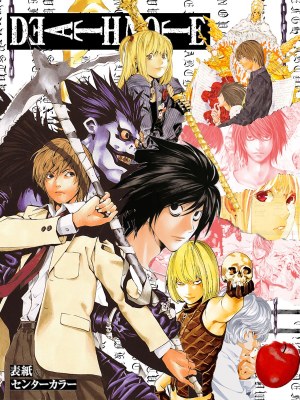
Death Note

Death Note

デスノート
2006 -2007 Madhouse NTV 37 episodes Completed
Psychological Thriller Mystery Supernatural Drama
Details & Synopsis
Light Yagami is seventeen, top of his class, and bored. Not restless-teenager bored. Philosophically bored, convinced that the world is irredeemably rotten and that the people running it are not equal to the task. Then a notebook falls from the sky. Any human whose name is written in it dies. Light picks it up, reads the instructions, and within forty-eight hours has decided he is God.

This is not a villain origin story. Light does not become the thing he becomes through corruption or trauma or a single catastrophic choice. He becomes it because the notebook revealed what was already there. The horror of Death Note is not what the notebook does. It is what Light does with it, calmly, methodically, with genuine conviction that he is correct.

Produced by Madhouse and directed by Tetsuro Araki, Death Note aired on NTV from October 2006 to June 2007. Thirty-seven episodes adapted from Tsugumi Ohba and Takeshi Obata's manga. The first twenty-five are as close to perfect television as the medium produced in the mid-2000s. The remainder are contested in ways that are worth understanding before you arrive at them.

The contest is L. An anonymous detective. No last name. No visible biography. A man who sits in hotel rooms eating cake and stacking sugar cubes and holds the single largest sustained record of solved cases in the world. He is assigned to find Kira, the name the internet gives to the unknown killer who appears to be executing criminals globally through untraceable cardiac arrest. L deduces within the first episode that Kira is in Japan. By the third he has narrowed it further. Death Note's first arc is a sustained cat-and-mouse between two people who are the most intelligent persons either of them has ever encountered, operating with incomplete information, neither willing to move without certainty and both moving constantly. It is one of the great dramatic constructions of its era.

In 2006 this show was downloaded faster than Conclave-Mendoi could release it. Not by the anime community. By everyone. Death Note crossed into spaces that had never heard of fansubs, had no context for seasonal anime, had no prior investment in the medium. It crossed because the premise translated instantly, because Light Yagami is a protagonist who works on people who have never watched anime in their lives, and because L is the kind of character who produces the specific obsession that makes people talk about a show to people who were not going to watch it. The mid-2000s fansub era had no larger single crossover event.

The second arc arrives. Near. Mello. The Wammy's House succession. Whether what follows L is adequate to what preceded him is the argument Death Note fans have been having since 2007 and have not resolved. Watch and form your own position. The first arc alone justifies every minute.
Alt Title デスノート
Studio Madhouse
Network NTV
Aired 2006 - 2007
Episodes 37
Genre Psychological Thriller, Mystery, Supernatural, Drama
Status Completed

Shinigami Realm & Eye Deal

The Shinigami Realm

Desolate Afterlife · Gamblers' Wasteland
The Shinigami Realm is a barren, decaying world inhabited by gods of death who extend their lives by writing human names. Most of the Shinigami shown are lethargic, bored and more interested in gambling or sleeping than watching the human world. Ryuk drops a Death Note into the human world largely because that stagnation has become unbearable to him.
Why it matters
The entire story begins because the human world looks more interesting to Ryuk than his own.

The King of Shinigami

Supreme Ruler · Notebook Authority
The Shinigami King sits at the top of the Shinigami hierarchy and controls the supply of Death Notes. Individual Shinigami normally receive a notebook through him, and the rules acknowledge his authority over ownership and replacement notebooks. He is important less as an active character than as proof that Ryuk and Rem are not operating outside a system. The Shinigami world has rules, rank and someone above them.

Using the Death Note Does Not Send You to a Special Hell

SPOILER!

Death Note users are uniquely barred from Heaven or Hell.

Ryuk tells Light that a human who uses the Death Note can neither go to Heaven nor Hell. It sounds like a special punishment until the rules reveal the larger truth: all humans eventually die, and the place they go is Mu, or Nothingness. The notebook does not create a separate damnation reserved for its users.
Why it matters
Ryuk's warning is not a supernatural morality clause. Death Note never gives Light a cosmic punishment system to fear. The consequences that matter are the ones created by his choices while he is alive.

The Eye Contract (50% Lifespan Sacrifice)

Half of Remaining Life · Names at a Glance
A human can trade half of their remaining lifespan to a Shinigami for the Shinigami Eyes. The eyes reveal a human's true name and remaining lifespan by looking at that person's face. For someone trying to use a Death Note, that removes the hardest requirement: learning the victim's real name.
Why it matters
Light repeatedly refuses the deal because his plan depends on living long enough to rule the world he wants to create. Misa accepts it because her priorities are completely different. Her arrival as the Second Kira is where the mechanic stops being hypothetical: Misa Arrives With the Shinigami Eyes.

Eye Deal Limitations & Masking

Owner Blindspot · The Face Still Has to Be Visible
Shinigami Eyes do not show the lifespan of another Death Note owner, although the owner's name can still be seen. The eyes also depend on actually seeing enough of a person's face. A sufficiently clear photograph or image can work; a face that is too small, obscured or otherwise unreadable cannot.
Why it matters
The Eyes are powerful, but they do not turn their owner into an all-knowing database. Identification still depends on visual access.

Compounded Eye Deals (Misa Amane Rule)

SPOILER! The Cost Is Paid Again
Giving up ownership also means losing the Shinigami Eyes, but the lifespan already paid for them is not returned. If the same person later makes another Eye Deal, half of whatever lifespan remains at that moment is sacrificed again. Misa does exactly this after regaining a Death Note.
Why it matters
The second deal does not rewind the first. Misa repeatedly treats her own lifespan as expendable when it can help Light. That willingness begins with her arrival as the Second Kira.

Shinigami Lifespan Harvesting

Human Life Extraction & Accumulation
When a Shinigami writes a human's name in their Death Note, the difference between the victim's natural lifespan and the moment of their premature death is added directly to the Shinigami's remaining life force, rendering Shinigami functionally immortal.

The Protection Paradox: How a Shinigami Can Die for a Human

SPOILER! Extending a Human Life · Gelus and Rem
Shinigami normally extend their existence by taking human life. The rule can reverse itself: if a Shinigami deliberately uses a Death Note to save a human they care about and thereby extends that human's life, the Shinigami dies. Gelus dies saving Misa, and Rem later dies after choosing Misa's survival over her own.
Why it matters
Light cannot kill Rem directly. He wins by arranging the board so that Rem's love for Misa forces Rem to destroy herself in Rem Kills L and Watari to Save Misa.

A Dead Shinigami's Remaining Life Passes to the Human They Saved

SPOILER! Gelus · Misa Amane
When a Shinigami dies because they used the Death Note to save a human, the lifespan that remained to the Shinigami is transferred to the person whose life was extended. Gelus dies protecting Misa, leaving the life he had accumulated behind with her.
Why it matters
Misa's repeated Eye Deals cut into a lifespan that was already altered by Gelus' sacrifice. The series deliberately makes her exact remaining time impossible for humans to calculate.