
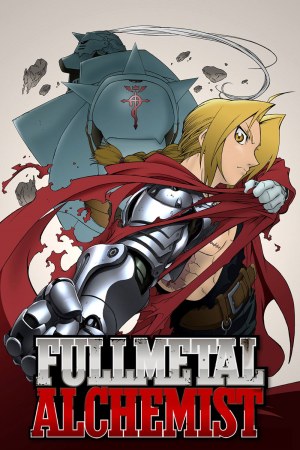
Fullmetal Alchemist

Fullmetal Alchemist

鋼の錬金術師
2003 -2004 Bones MBS 51 episodes Completed
Action Adventure Drama
Details & Synopsis
The year is 1910, approximately. The country is Amestris, approximately. Two boys in a rural town teach themselves alchemy from their absent father's books and decide to do the one thing every alchemical text agrees cannot be done, human transmutation, the resurrection of the dead. Their mother. They are children. They do not survive the attempt intact.
Edward Elric loses his right arm and left leg. Alphonse Elric loses everything, his entire body, seized by the Gate, leaving behind only a soul that Ed binds to a suit of armour in the seconds before he loses consciousness. The exchange is the series' foundation and its recurring nightmare: the law of equivalent exchange, the principle that underpins all alchemy, applied to the thing it was never meant to touch. They paid. They did not get what they paid for.
Produced by Bones and directed by Seiji Mizushima, Fullmetal Alchemist aired on MBS from 2003 to 2004. Fifty-one episodes. It began adapting Hiromu Arakawa's manga faithfully and then, as the weekly production overtook the still-running manga, gradually moved into an original storyline. What followed is one of the most remarkable pivots in anime history: the production team, with Arakawa's blessing and a handful of her discarded plot threads, invented their own story. Their own villain. Their own ending.
The ending they arrived at is darker than Brotherhood's. More ambiguous. More interested in the cost of the boys' choices than in the resolution of the world's politics. Dante. The Gate. What is on the other side of it. A finale that refuses the comfort of restoration and insists that some debts cannot be paid back, they can only be carried forward.
Brotherhood is the manga. Faithful, complete, structurally confident, the story Arakawa intended. This is something else. A parallel history. A what-if that the people who made it took entirely seriously. Both versions are essential. They are not the same show wearing the same premise. They are two writers asking the same question and arriving at different answers about what human beings owe each other and what alchemy, the science of transformation, of making one thing into another, actually costs when the thing being transformed is a person.
Watch both. Then argue about which one broke you worse.
Alt Title 鋼の錬金術師
Studio Bones
Network MBS
Aired 2003 - 2004
Episodes 51
Genre Action, Adventure, Drama
Status Completed

2003 Alchemy Mechanics

How to Read 2003 Alchemy

This page is for the rules the 2003 anime ultimately makes its own. Brotherhood and the manga answer several of these questions differently.

The important part is not memorizing a physics manual. It is following how the show changes the brothers' understanding of the Gate, Red Stones, Homunculi and the energy beneath alchemy as they get closer to the truth.

The Gate

SPOILER!

2003 continuity · knowledge, passage and a world on the other side

At first, the Gate is the place Edward and Alphonse encounter when human transmutation goes wrong: an impossible threshold that takes a toll and exposes an alchemist to knowledge they were never meant to reach.

Late in the 2003 series, that idea becomes literal in a way unique to this adaptation. The Gate connects Amestris to another world resembling early twentieth-century Earth, and Edward eventually crosses through it.
What changed
The Gate begins as the punishment behind the brothers' childhood mistake. By the ending it becomes the mechanism that breaks the assumption that Amestris is a closed system at all.

Red Stones

Incomplete Philosopher's Stone material · temporary shortcut
Red Stones are imperfect substitutes for a completed Philosopher's Stone. Cornello's miracles in Liore and later experiments show why they are so tempting: they let alchemy produce results that appear to exceed ordinary limits.

They are also part of how the 2003 Homunculi sustain themselves.
Why it matters
Red Stones keep giving the brothers a glimpse of the solution they want while teaching them not to trust anything that looks like a cheap version of the Stone.

True Philosopher's Stone

SPOILER! Human lives condensed into usable alchemical power
The completed Philosopher's Stone is not simply a rare mineral waiting to be discovered. In 2003, creating one requires human lives on a horrifying scale.

That truth changes the brothers' quest. Restoring their bodies stops being a problem of finding the right object and becomes a question of whether they can accept an object whose existence already means somebody else paid the price.
Why it matters
The Stone does not defeat Equivalent Exchange. It hides the exchange inside other people.

What a Homunculus Is in 2003

SPOILER!

Failed human transmutation · Red Stones · a life that should not exist

The 2003 Homunculi are tied to failed attempts to bring dead people back. The result is not the original human restored, but a new being carrying the body, memories or emotional traces of the person the alchemist tried to recreate.

Dante uses Red Stones to stabilize and control these beings, while the physical remains of the intended human can weaken them and interrupt their regeneration.
Why it matters
This makes every major Homunculus conflict personal. They are not merely monsters named after sins; several exist because somebody loved a dead person enough to break the taboo.