
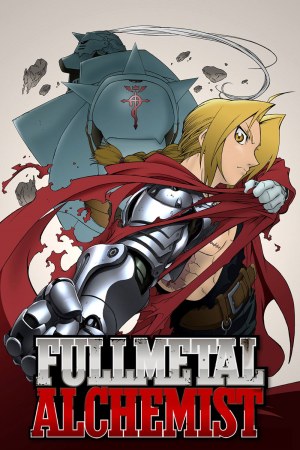
Fullmetal Alchemist

Fullmetal Alchemist

鋼の錬金術師
2003 -2004 Bones MBS 51 episodes Completed
Action Adventure Drama
Details & Synopsis
The year is 1910, approximately. The country is Amestris, approximately. Two boys in a rural town teach themselves alchemy from their absent father's books and decide to do the one thing every alchemical text agrees cannot be done, human transmutation, the resurrection of the dead. Their mother. They are children. They do not survive the attempt intact.
Edward Elric loses his right arm and left leg. Alphonse Elric loses everything, his entire body, seized by the Gate, leaving behind only a soul that Ed binds to a suit of armour in the seconds before he loses consciousness. The exchange is the series' foundation and its recurring nightmare: the law of equivalent exchange, the principle that underpins all alchemy, applied to the thing it was never meant to touch. They paid. They did not get what they paid for.
Produced by Bones and directed by Seiji Mizushima, Fullmetal Alchemist aired on MBS from 2003 to 2004. Fifty-one episodes. It began adapting Hiromu Arakawa's manga faithfully and then, as the weekly production overtook the still-running manga, gradually moved into an original storyline. What followed is one of the most remarkable pivots in anime history: the production team, with Arakawa's blessing and a handful of her discarded plot threads, invented their own story. Their own villain. Their own ending.
The ending they arrived at is darker than Brotherhood's. More ambiguous. More interested in the cost of the boys' choices than in the resolution of the world's politics. Dante. The Gate. What is on the other side of it. A finale that refuses the comfort of restoration and insists that some debts cannot be paid back, they can only be carried forward.
Brotherhood is the manga. Faithful, complete, structurally confident, the story Arakawa intended. This is something else. A parallel history. A what-if that the people who made it took entirely seriously. Both versions are essential. They are not the same show wearing the same premise. They are two writers asking the same question and arriving at different answers about what human beings owe each other and what alchemy, the science of transformation, of making one thing into another, actually costs when the thing being transformed is a person.
Watch both. Then argue about which one broke you worse.
Alt Title 鋼の錬金術師
Studio Bones
Network MBS
Aired 2003 - 2004
Episodes 51
Genre Action, Adventure, Drama
Status Completed

The Philosopher's Stone

The Stone Is the Same Goal for 51 Episodes. What It Means Is Not.

SPOILER!
Edward and Alphonse begin with an almost childlike version of the quest: find the Philosopher's Stone, bypass Equivalent Exchange and restore their bodies.

Every major discovery makes that sentence harder to say with a straight face.

This page follows the Stone as an idea: miracle, fake, research project, atrocity, living person and finally a choice the brothers have to make about what they are willing to spend on each other.

First the Stone Is a Rumor People Can Exploit

Liore · Red Stones · false miracles

Before the brothers know how the Stone is made, they repeatedly meet people willing to build power around the appearance of having one.

Cornello Shows Why a Fake Stone Is Still Dangerous

Episodes 1–2

Cornello's Stone is not the completed artifact Edward wants, but it lets him perform enough impossible-looking alchemy to build religious authority in Liore.

When it fails, the brothers learn almost nothing useful about where a real Stone is. They do learn how badly people want to believe in one.
Why it matters
The first Stone in the series is counterfeit because the story wants the audience to understand immediately that the object has social power before its actual mechanics are known.

Red Stones Keep Offering the Shortcut in Pieces

Cornello · Xenotime · Homunculi

The 2003 anime repeatedly introduces Red Stones as incomplete Philosopher's Stone material. They can amplify alchemy dramatically, but they are unstable, limited and tied to experiments the brothers increasingly distrust.
Why it matters
Red Stones prevent the real Stone from remaining an abstract legend. Edward keeps seeing evidence that the shortcut is possible before he understands what completing it would require.

Then the Brothers Learn What the Stone Is Made From

Marcoh → Laboratory 5

The quest changes once "find the Stone" becomes "find out who somebody is willing to turn into the Stone."

Marcoh's Research Connects the Stone to Ishbal

SPOILER!

Episodes 14–18

Marcoh knows the Philosopher's Stone is not harmless theory because his research was used during the Ishbal war.

His notes eventually send the brothers toward Laboratory 5, but the important revelation comes before they ever reach the building: State research and mass killing have already occupied the same history.
What changed
The Stone stops being morally neutral knowledge. Ed now knows the people most capable of helping him understand it are also people carrying guilt over what that knowledge was used to do.

Laboratory 5 Shows the Recipe at Human Scale

SPOILER!

Episodes 19–22

The Fifth Laboratory brings prisoners together as ingredients for a Stone and puts Edward in position to complete the transmutation.

This is the closest the series comes to handing Ed his original wish exactly as requested.
Why it matters
He refuses. The brother who began by saying equivalent value is all that matters discovers a price he is not willing to pay even if the result could restore Al.

Scar Accepts the Same Equation and Changes the Victims

Liore · Episodes 39–42

Scar's plan proves that understanding the atrocity behind the Stone does not automatically make somebody reject using it.

Liore Is Engineered Toward Another Mass Death

SPOILER!

Military invasion as transmutation material

The conflict in Liore is manipulated until Scar has both a transmutation array and an approaching military force large enough to become the cost.

Scar evacuates civilians and intends the soldiers entering the city to supply the lives.
Why it matters
The method mirrors the violence he hates. Scar's answer to Ishbal is not to reject the logic that human lives can become alchemical fuel; it is to decide who deserves to be used as fuel.

The Completed Stone Is Alphonse

SPOILER!

Episode 42

Scar saves Al from Kimblee's attempt to turn the armor into a bomb by completing the Philosopher's Stone through Al's body.

Suddenly the brothers are no longer Stone hunters. Alphonse himself contains the power every major faction has been pursuing.
What changed
The moral question cannot be kept theoretical anymore. If a Stone is made from lives, and the Stone is now Al, using that power means asking what those lives inside him are for.

Dante Needs the Stone Because Her Body Keeps Failing

The conspiracy finally has a personal motive

The late-series reveal turns repeated Stone-making schemes into part of a cycle Dante has used to prolong her own life.

Immortality Does Not Stop Decay. It Moves It.

SPOILER!

Soul transfer and rotting bodies

Dante and Hohenheim used Philosopher's Stone power to transfer their souls into new bodies. The process extends life, but the replacement bodies deteriorate.

Dante therefore needs future Stones and future bodies to keep the solution going.
Why it matters
The person orchestrating so much sacrifice is not pursuing transcendence for humanity. She is maintaining a private escape from death that never actually solves mortality; it only postpones it at somebody else's expense.

The Homunculi Are Promised Humanity So They Will Help Build the Next Stone

SPOILER!

Desire turned into labor

Dante tells the Homunculi that the Philosopher's Stone can make them human. Their work creating conflicts and manipulating alchemists therefore feeds the same cycle that sustains her.
Why it worked
Dante does not need every Homunculus to love or trust her. She only needs each one to believe the next Stone might contain the thing they are missing.

The Final Test Is What Edward and Alphonse Do Once the Stone Is Real

The goal is achieved in the worst possible form

By the final arc, the Stone is no longer a legend. The brothers have the power they spent years looking for, and nearly every reason they once wanted it has become harder to justify.

Al Uses the Stone to Restore Edward

SPOILER!

Episode 50

When Edward is killed, Alphonse uses the Philosopher's Stone within himself to bring his brother back.

It is the kind of impossible restoration the Stone was supposed to make possible from the beginning.
Why it matters
The first truly personal use of the completed Stone is not Edward choosing to fix his own body. It is Al choosing Edward over himself.

Edward Gives Himself Up to Restore Alphonse

SPOILER!

Episode 51

Edward answers Al's sacrifice with one of his own, transmuting himself so Al can return in a human body.

The result does not neatly restore the brothers to the lives they expected when they began the journey. Edward ends up beyond the Gate while Al returns without the years of memories that followed their original transmutation.
What changed
The Stone never becomes the clean reset button the brothers imagined. By the time they possess the shortcut, their choices are about one another rather than about winning back everything they lost.