
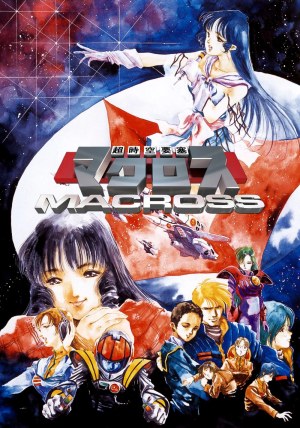
Super Dimension Fortress Macross

Super Dimension Fortress Macross

超時空要塞マクロス
1982 -1983 Tatsunoko Production / Studio Nue MBS 36 episodes Completed
Action Mecha Sci-Fi Romance Musical
Details & Synopsis
In 1999, an alien warship crashes on a remote island and humanity spends a decade reverse-engineering technology it barely understands. In 2009, the ship, rebuilt and renamed the Macross, launches on its maiden voyage. The aliens it came from show up the same day to reclaim it. What follows is a two-year war fought across the solar system, inside a city-sized battlefortress, between a civilization of giant humanoids and a species of smaller ones who discovered something the Zentradi never had: culture.

Produced by Tatsunoko Production and Studio Nue, Super Dimension Fortress Macross aired on MBS from 1982 to 1983. Thirty-six episodes that invented conventions the mecha genre is still running on today. The love triangle between ace pilot Hikaru Ichijyo, pop idol Lynn Minmay, and officer Misa Hayase is still being argued about. The variable fighters, transforming from jet to humanoid to attack mode, set a template that Transformers would borrow and Gundam would spend decades trying to answer. The moment a song stops a war is still one of the most quietly radical ideas ever animated.

In the West, Macross was chopped up, merged with two unrelated series, and released as Robotech in 1985. Harmony Gold then spent thirty years using that license to block official Macross releases outside Japan. Fans distributed fansubs of the original specifically as an act of reclamation. The history of how Westerners actually saw this show is inseparable from the history of fansub culture itself.

Watch the original. Watch Do You Remember Love? immediately after. Then watch Macross Plus and understand why Shinichiro Watanabe made Cowboy Bebop the way he did.
Alt Title 超時空要塞マクロス
Studio Tatsunoko Production / Studio Nue
Network MBS
Aired 1982 - 1983
Episodes 36
Genre Action, Mecha, Sci-Fi, Romance, Musical
Status Completed

Variable Fighter Tech

Overtechnology Changes What Humanity Can Build

The alien ship becomes the basis for the Macross and its new weapons

The war begins because humanity has spent years rebuilding technology recovered from the enormous alien ship that crashed on Earth and became the SDF-1 Macross.

The television series does not need a catalogue of every system reverse-engineered from that discovery. What matters while watching is the scale of the jump: humanity enters the conflict with a transformed alien battleship and weapons built for an enemy it has never actually met.
Why it matters
The Macross is not just the place where the story happens. Its existence is the reason Earth is suddenly visible to a much larger war.

The VF-1 Has Three Forms for Three Different Problems

Fighter · GERWALK · Battroid

The VF-1 Valkyrie can change between Fighter, GERWALK and Battroid forms.

Fighter gives it the speed and handling of an aircraft. Battroid gives the pilot a humanoid body suited to fighting giant opponents and operating around structures. GERWALK sits between them, keeping the aircraft body while deploying the arms and legs.
How you can tell
Macross rarely treats transformation as a finishing move. Pilots switch forms in the middle of movement because each shape solves a different problem.

GERWALK Is the Valkyrie's Useful Middle Ground

Aircraft body · deployed limbs · rapid low-speed maneuvering

GERWALK is the Valkyrie's intermediate configuration between Fighter and Battroid.

It preserves much of the aircraft's shape while deploying the arms and legs, letting a pilot brake hard, hover close to the ground or a ship, change direction quickly and interact with the environment without committing to the full humanoid form.
Why it matters
GERWALK is one of the clearest examples of why the VF-1 transforms at all. The forms are useful because combat keeps changing faster than one machine shape can comfortably handle.

The VF-1 Appears in Several Recognizable Variants

VF-1A · VF-1D · VF-1J · VF-1S

The television series uses several VF-1 variants rather than one identical Valkyrie for every pilot.

The VF-1D is seen early as a two-seat machine. Hikaru becomes closely associated with the VF-1J, while Roy Focker's Skull-marked VF-1S is presented as a command model with four head-mounted laser guns.
How you can tell
The easiest visual distinction is the head unit. Macross uses those differences to make individual Valkyries readable even when many similar machines share the screen.

Gunpods and Missiles Keep the Valkyrie a Fighter First

Handheld gunpod · external missiles · anti-ship firepower

The VF-1's most familiar weapon is the gunpod it carries in Battroid and GERWALK and mounts beneath the aircraft in Fighter form. Valkyries also carry missiles for targets ranging from enemy pods to much larger spacecraft.
Why it matters
The weapons reinforce the design idea behind the machine. A Valkyrie may look like a giant robot in Battroid, but it still fights with the speed, range and weapons logic of an aircraft.

The Armored Valkyrie Trades Mobility for a Wall of Missiles

Heavy external armor · missile load · jettisoned when mobility matters again

Hikaru's VF-1J can be fitted with a heavy Armored Pack that covers the Battroid in additional protection and missile launchers.

The equipment makes the Valkyrie far heavier and prevents normal transformation while it remains attached. When the armor has served its purpose, it can be discarded so the VF-1 can move and transform normally again.
Why it matters
Macross treats equipment as a tradeoff. More armor and firepower are useful only until the fight demands the flexibility that made the Valkyrie valuable in the first place.