
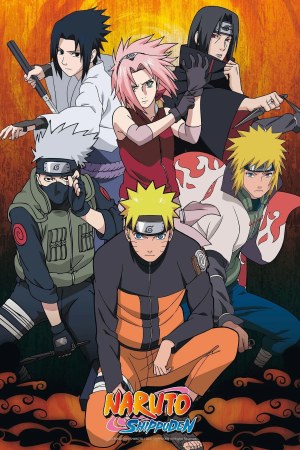
Naruto: Shippuden

Naruto: Shippuden

NARUTO -ナルト- 疾風伝
2007 -2017 Studio Pierrot TV Tokyo 500 episodes Completed
Action Adventure Martial Arts
Details & Synopsis
Naruto returns to Konoha after two and a half years of training with Jiraiya. He is taller, a little less reckless, and still nowhere near ready for what has been moving while he was gone. The Akatsuki are collecting tailed beasts. Sasuke has chosen Orochimaru. Every promise Naruto made as a child is about to become an adult problem.

Naruto: Shippuden ran from 2007 to 2017 for 500 episodes, which is long enough to contain some of the best material in the franchise and enough filler to make episode guides a basic survival tool. Both things are true. The Kazekage Rescue arc announces the scale. Pain turns the entire story back toward the loneliness Naruto started with. Itachi changes meaning every time the series tells you one more thing. The Fourth Shinobi World War eventually becomes bigger than the show can comfortably hold, but when Shippuden lands, it lands with ten years of accumulated weight behind it.

This was also the point where the old fansub rhythm collided with legal simulcasting. Dattebayo had been part of weekly Naruto life for years, then stopped when official same-week access finally became real. That transition is part of the history. The community did not vanish overnight, but the way people watched together changed permanently.

Five hundred episodes. Use a filler guide. Nobody gives out medals for pretending you did not.
Alt Title NARUTO -ナルト- 疾風伝
Studio Studio Pierrot
Network TV Tokyo
Aired 2007 - 2017
Episodes 500
Genre Action, Adventure, Martial Arts
Status Completed

4th Great Shinobi War & Jūbi

A War Declared Over Two Jinchūriki

SPOILER!

Five Kage Summit · Naruto & Killer B Withheld · Obito Declares War

Obito does not declare the Fourth Shinobi World War because the Five Great Nations invade Akatsuki territory. He declares it after the Kage refuse to surrender Naruto and Killer B, the two remaining jinchūriki he still needs for the Eye of the Moon Plan. The war begins as a demand for two people and immediately forces villages with generations of hostility to decide whether protecting them is worth fighting together.
What changed
The Five Kage Summit was supposed to coordinate a response to Akatsuki. It ends by creating something the shinobi world had never sustained before: a military alliance of the major villages against a common enemy.

The Eye of the Moon Plan Is the Real Objective

SPOILER!

Tailed-Beast Collection · Ten-Tails Revival · Infinite Tsukuyomi

The battlefield is enormous, but territorial conquest is never the real prize. Obito needs the chakra of all nine tailed beasts to revive the Ten-Tails and move the Eye of the Moon Plan toward completion. That is why Naruto and Killer B matter more strategically than any village, fortress, or stretch of land the armies fight over.
Why it matters
The war can look like a conventional clash between Akatsuki and the Five Great Nations, but its actual objective is extraction. The Allied Forces are fighting to stop two living targets from becoming the final components of a much larger mechanism.

Five Villages Become One Army

SPOILER!

Former Enemies · Shared Headbands · A Single Command Structure

The alliance is more radical than simply putting five armies on the same map. Shinobi who were raised under different village doctrines, fought in earlier wars, and in some cases personally hated one another are reorganized under a shared command structure. The old village symbols do not disappear, but for the duration of the war they stop being the most important identity on the battlefield.
Why it matters
Akatsuki spent years exploiting the distrust between villages. The war forces those same villages to pool intelligence, manpower and leadership quickly enough that old political divisions cannot be allowed to decide battlefield decisions.

The Divisions Are Built Around Jobs, Not Villages

SPOILER!

Frontline Combat · Mid-Range Support · Intelligence · Medical & Sensor Roles

The Allied Forces are deliberately mixed. The point is not to send one village north and another village south; it is to distribute specialties across divisions so the army can answer different kinds of threats without falling back into five separate national chains of command. That also puts former enemies beside one another where cooperation has to become practical instead of ceremonial.
Why it worked
A mixed force makes Akatsuki fight a shinobi system instead of five isolated militaries. Information, sealing teams, sensors, medics and frontline specialists can be redirected as the enemy changes shape.

Shikaku and Inoichi Turn the Battlefield Into a Network

SPOILER!

Central Strategy · Long-Range Communication · Orders Move Faster Than Armies

The Allied headquarters matters because the war is too large for any field commander to see in full. Shikaku Nara receives reports from multiple fronts and converts them into revised strategy while Inoichi Yamanaka relays those decisions across enormous distances. The result is a command network that can react to battles happening far beyond visual range.
Why it worked
Shikaku does not need to personally win every engagement. He needs the right unit to learn what another unit has already discovered, and Inoichi makes that information move quickly enough to matter.

Naruto and Killer B Are Hidden From Their Own War

SPOILER!

Island Turtle · Strategic Containment · Protect the Remaining Jinchūriki

The alliance begins the war by keeping its two most valuable fighters away from it. Naruto and Killer B are concealed because losing either one risks completing Akatsuki's collection of tailed-beast chakra. From the commanders' perspective, protecting them is more important than the battlefield advantage their power could provide.
Why it worked
For as long as their location stays secret, Akatsuki cannot finish the plan that caused the war. The strategy fails only when keeping Naruto uninformed becomes impossible and he chooses to enter the battlefield himself.

Kabuto Changes Obito's Army Overnight

SPOILER!

Edo Tensei Alliance · Dead Shinobi Reintroduced · Madara Held in Reserve

Obito enters the war with White Zetsu manpower, but Kabuto gives him something far more disruptive: a reanimated army assembled from dead shinobi whose abilities, reputations and personal relationships are already known to the people forced to fight them. Kabuto is an ally of convenience, not a subordinate, and the real Madara Uchiha is the leverage that makes Obito take the partnership seriously.
What changed
The enemy no longer has to recruit enough elite living shinobi to match five nations. Kabuto can turn the shinobi world's own dead into reusable battlefield assets and psychological weapons.

Edo Tensei Makes Memory a Weapon

SPOILER!

Regenerating Bodies · Familiar Techniques · Emotional Warfare

The Reanimation Jutsu does more than put powerful dead shinobi back on the field. It forces the living to fight former teachers, parents, commanders, friends and legends while those bodies regenerate from damage that would end an ordinary battle. Sealing becomes as important as defeating the opponent, because simply killing an Edo Tensei body does not solve the problem.
Why it matters
The technique attacks the alliance twice: physically through nearly disposable elite soldiers, and emotionally by making personal history part of the battlefield.

White Zetsu Turns Identification Into a Battlefield

SPOILER!

Mass Army · Chakra Mimicry · Infiltration Behind Allied Lines

White Zetsu gives Obito the numbers to fight a continental alliance, but its more dangerous contribution is confusion. Once Zetsu units begin copying Allied chakra signatures and appearances, the war is no longer divided neatly into a front line and a safe rear area. Shinobi have to prove that the person beside them is actually who they appear to be.
What changed
Medical and support areas become vulnerable to an enemy that can imitate trusted allies. Naruto's ability to sense hostile intent after gaining control of Kurama's chakra becomes strategically valuable because it solves a problem ordinary identification methods cannot reliably solve.

Naruto Enters the War as a Distributed Reinforcement

SPOILER!

Shadow Clones · Hostile-Intent Sensing · Multiple Fronts Reinforced at Once

Naruto does not simply arrive at one battlefield and become its strongest fighter. He sends chakra-enhanced shadow clones to different fronts, allowing one person to reinforce multiple divisions while also identifying disguised White Zetsu by sensing their hostile intent. His arrival changes the alliance from an army trying to survive separate crises into an army that can suddenly share the same elite asset across those crises.
Why it matters
This is one of the few moments where Naruto's signature technique becomes a strategic resource at army scale rather than just a combat trick.

When Edo Tensei Ends, Madara Does Not

SPOILER!

Kabuto Defeated · Reanimations Released · Madara Severs the Contract

Forcing Kabuto to release Edo Tensei should remove the enemy's reanimated army from the board. It works on nearly everyone. Madara recognizes what is happening, performs the release seals himself and severs his contract with the summoner before his soul can return. The technique designed to give Kabuto control over the dead leaves its strongest resurrection independent.
What changed
The alliance wins the larger Edo Tensei problem and simultaneously loses the one reanimation it most needed to disappear. Madara is no longer Kabuto's weapon; he is his own actor on the battlefield.

The Ten-Tails Ends the Conventional War

SPOILER!

Army vs. Army Becomes Survival Against a Single Weapon

Once the Ten-Tails is revived, the structure of the conflict changes again. Divisions, territorial fronts and numerical superiority matter less because the enemy now possesses a single creature capable of attacking across enormous distances and erasing command infrastructure in one strike. The Allied Forces are no longer trying to defeat an opposing army in the usual sense; they are trying to remain coordinated long enough to stop a world-ending mechanism.
What changed
The Jūbi is not reinforcement for Akatsuki's army. It replaces the need for that army.

Initial Revival: Incomplete Ten-Tails

SPOILER!

Partial Eight- & Nine-Tails Chakra · Unstable First Form

Obito revives the Ten-Tails without fully capturing Naruto or Killer B by substituting fragments of their tailed-beast chakra: the Eight-Tails tentacle Killer B left behind and Nine-Tails chakra carried by the Gold and Silver Brothers. The result is still powerful enough to overwhelm conventional battlefield scale even though the revival is incomplete.
How you can tell
The first revived form is low to the ground and grotesquely asymmetrical, with a huge eye, gaping mouth and a mass of spike-like projections across its back rather than the later upright humanoid silhouette.

Second Form: The Jūbi Stands Up

SPOILER!

Bipedal Transformation · Long-Range Tailed-Beast Bombs

The Ten-Tails reshapes into a tall, emaciated bipedal form whose offensive range becomes a strategic problem rather than merely a frontline one. Its Tailed-Beast Bombs can be aimed far beyond the immediate battlefield, allowing Obito and Madara to attack the command system supporting the Allied Forces instead of only the soldiers in front of them.
How you can tell
The creature is now upright on two legs with an elongated torso and arms, losing the first form's low, spiked-husk profile. This is the form associated with the long-range barrage that targets Allied headquarters.

The God Tree: The Jūbi Returns to Its Root

SPOILER!

Shinju · Chakra Absorption · Infinite Tsukuyomi Mechanism

The Ten-Tails and the God Tree are not unrelated monsters occupying the same war. The Jūbi is tied directly to the Shinju, and the conflict eventually exposes the creature as part of the mechanism needed to reclaim chakra and prepare the Infinite Tsukuyomi. What began as a tailed-beast superweapon becomes something closer to the biological infrastructure of the plan itself.
How you can tell
The battlefield monster gives way to an enormous rooted tree whose branches and roots spread across the terrain to seize living shinobi and drain their chakra. The visual language changes from beast anatomy to a world-scale plant network.

Headquarters Dies While Still Giving Orders

SPOILER!

Jūbi Long-Range Strike · Shikaku's Final Strategy · Command Transfers to the Field

When the Ten-Tails targets Allied headquarters, Shikaku and Inoichi understand that they cannot escape in time. They use the remaining moments before impact to transmit one final strategy to the battlefield instead of spending them trying to save themselves. Their deaths destroy the alliance's central command post, but not the command logic they built.
Why it matters
The war has spent hundreds of episodes teaching the alliance to operate as a network. Destroying the room at the center of that network hurts enormously, but by then the people in the field are capable of carrying the plan forward.

Naruto Turns the Alliance Into One Chakra Network

SPOILER!

Kurama Chakra Cloaks · Shared Protection · Thousands Fight Through One Source

Near the war's climax, Naruto distributes Kurama's chakra across the Allied Forces instead of keeping that power concentrated inside himself. Thousands of shinobi receive protective chakra cloaks and can continue operating against attacks that had been tearing conventional formations apart. The jinchūriki the alliance originally hid as a liability becomes the connective tissue holding the surviving army together.
Why it matters
The symbolic reversal is almost as important as the power boost. The Nine-Tails was once the reason Naruto was isolated; during the war, its chakra is literally shared across the shinobi world to keep other people alive.