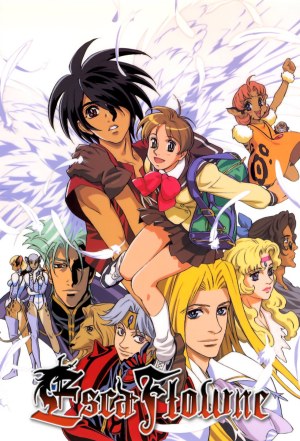
The Vision of Escaflowne

The Vision of Escaflowne

Escaflowne / 天空のエスカフローネ
1996 Sunrise TV Tokyo 26 episodes Completed
Fantasy Adventure Mecha Romance
Details & Synopsis
Hitomi Kanzaki is a high-school track athlete with a talent for tarot readings and an inconvenient habit of seeing things before they happen. During an ordinary practice session, a young swordsman named Van appears in front of her while fighting a dragon. Hitomi is pulled with him to Gaea, a world where Earth hangs in the sky as the Mystic Moon and kingdoms wage war using armored Guymelefs.

Van is not simply a warrior. He is the young king of Fanelia, and his kingdom is destroyed almost as soon as Hitomi arrives. Their escape brings them together with the elegant knight Allen Schezar and draws them into the expanding war against the Zaibach Empire. At the center of it all is Escaflowne, Van's ancient Guymelef, and a conflict where prophecy, probability and human desire become weapons as important as swords.

Escaflowne is unusual because none of its identities cancel the others out. It is a mecha series, a fantasy quest, a war story and a romance in the same twenty-six episodes. Hitomi's emotional choices matter to the mechanics of the plot instead of sitting beside them, while Van, Allen, Folken and Dilandau keep the war personal even when Zaibach's plans become enormous.

Western audiences encountered the series in several very different forms. Bandai released the original version for home video, while Fox Kids attempted a heavily reworked television version in 2000 and YTV carried it in Canada. That contrast between edited broadcast anime and the fuller original release makes Escaflowne especially at home in AnimeHistory's archive of how Western fans actually discovered these shows.
Alt Title Escaflowne / 天空のエスカフローネ
Studio Sunrise
Network TV Tokyo
Aired 1996
Episodes 26
Genre Fantasy, Adventure, Mecha, Romance
Status Completed

Fansub & Scanlation History

A 1996 Series Arrives on Tape

Sunrise · 26 TV episodes · April-September 1996

The Vision of Escaflowne finished airing in Japan on September 24, 1996. Hitomi's journey to Gaea, Van's war with Zaibach and Yoko Kanno's music gave the series a following well beyond the usual mecha crowd. For English-speaking fans without a licensed release, the first route into that story was often a copied videotape passed between collectors and university anime clubs. Some of those early subtitles survive only as names in tape catalogs.

MIT Shows Episodes 1 and 2

November 8, 1996 · American anime-club screening

MIT Anime Club screened Escaflowne episodes 1 and 2 on November 8, 1996, only weeks after the Japanese television finale. The club returned in spring 1997 for additional two-episode screenings, reaching episodes 15 and 16 by May 9. That is an unusually detailed calendar of how quickly an American club could follow a new Japanese series. The program does not name the subtitler or say whose tapes were projected.

SOURCE: https://anime.mit.edu/showings/history

E. Monsoon Studios and the Ten Documented Episodes

Collector VHS inventory · 1-4 and 9-14

The Senshi Fansubs tape inventory credits E. Monsoon Studios with Escaflowne episodes 1-2, 3-4, 9-10, 11-12 and 13-14. Those five two-episode tapes account for ten episodes, mostly graded Good or Good Plus by the collector. Another VHS collector listing also credits E. Monsoon with the opening pair. The absent 5-8 block is a gap in the surviving inventory, not proof the group never worked on those episodes. Nothing in these lists yet establishes the last episode E. Monsoon actually subtitled.

SOURCE: https://senshifansubs.wordpress.com/tape-lists/trade-list/

The Other Names on the 1990s VHS Trail

SilverWynd · Central Anime · multiple early teams

Escaflowne was not limited to one English VHS edition. In February 2022, a collector digitizing old tapes recalled owning separate copies credited to SilverWynd and Central Anime. They later said the recordings had been uploaded to the Internet Archive, although the exact items have not been independently matched to those comments. Those two attributions matter because the series circulated during a brief but crowded period before Bandai's official subtitled tapes reached stores.

SOURCE: https://www.reddit.com/r/animevhs/comments/sg1r1j

How Crowded Was the VHS Scene?

1997-1999 · Retrospective fansub index

A later fansub index preserved by Fanlore lists Beefbowl Anime, Central Anime, Great Muto Anime, HECTO, Jimaku Animation and Ryuujin among groups reported to have finished Escaflowne in 1997. The same list names Arctic Animation, Dragonfly Anime, Faceless Minions, Invader Productions and SUGOI! for 1998, followed by Studio Sabaku in 1999. Those completion years come from a retrospective database, not a collection of surviving original release announcements. They show how many names attached themselves to the show, but they cannot tell us which tapes carried completely independent translations.

SOURCE: https://fanlore.org/wiki/Vision_of_Escaflowne
SilverWynd and Central Anime Were Not Necessarily the Same Script

Collector testimony · Two surviving tape versions

One collector's account specifically describes two Escaflowne VHS versions, one credited to SilverWynd and the other to Central Anime. That does not establish a full twenty-six-episode run for either group, but it gives the older credits a physical basis. Comparing their opening cards, dialogue, timing and credits with E. Monsoon copies would help show where one translation ended and another began. For now, the separate names deserve to stay separate.

SOURCE: https://www.reddit.com/r/animevhs/comments/sg1r1j

Phantom Moon or Mystic Moon?

A tiny translation choice remembered decades later

A fan trying to identify an old Escaflowne cassette in 2022 remembered the subtitles calling Earth the 'Phantom Moon' rather than the more familiar 'Mystic Moon.' It is a wonderfully specific memory, and the sort of wording that can distinguish one VHS translation from another. Unfortunately, the collector could not identify the group from that line alone. Until someone matches the phrase against a surviving copy, neither SilverWynd nor Central Anime can claim it as a confirmed signature.

SOURCE: https://www.reddit.com/r/animevhs/comments/sg1r1j

Bandai Brings the Uncut Story to American VHS

AnimeVillage · September-December 1998

Bandai Entertainment's AnimeVillage label began releasing Escaflowne on officially subtitled North American VHS in September 1998. Eight volumes covered the full twenty-six-episode television series: four episodes on each of the first two tapes, then three episodes on each of the remaining six. For collectors who knew Gaea from copied fansubs, the retail editions offered a way to own the Japanese-language story in a consistent, licensed set. The 2000 theatrical film is a separate work and is not part of these twenty-six episodes.

SOURCE: https://www.escaflowne.co.uk/HomeVid.html

The Best Collection Was a Different Cut

1999 · Three commercial VHS tapes

AnimeVillage also sold a three-tape Best Collection that condensed the television story. That shorter set can be mistaken for another complete run when it turns up in old sale lists, but it was not simply the same eight-volume English-subtitled edition packed into fewer cassettes. For anyone piecing together Escaflowne's VHS history, the distinction between the full television release and the abridged Best Collection is important.

SOURCE: https://www.escaflowne.co.uk/HomeVid.html

Fans Argue About Buying the Official Tapes

December 1998 · A contemporary Usenet debate

A December 1998 discussion about fansubbing ethics named Escaflowne directly. One participant said they knew fansub owners who were not buying AnimeVillage's commercial tapes. Others argued that watching fan-subtitled anime encouraged purchases and helped create an audience for imported Japanese releases. Neither side had a reliable sales study to settle the argument. The discussion does show the pressure fansub culture faced as the exact shows it had helped circulate became available in American stores.

SOURCE: https://groups.google.com/g/rec.arts.anime.fandom/c/hjNBWLXwYhw

Fox Kids Rebuilds Escaflowne for Saturday Morning

August-October 2000 · Edited US television version

The Fox Kids television edition in 2000 was a different Escaflowne from the one fans had watched on Japanese tapes. The broadcaster began with material from the original second episode, changed the running order and cut or revised scenes for its target audience. Portions of Yoko Kanno's music were replaced, while the fantasy romance and Hitomi's place in the story were pushed behind the action. American viewers received only part of the edited run before it disappeared from the schedule.

SOURCE: https://www.escaflowne.co.uk/Fox.html

The Questions Fans Asked Fox Kids

August 25, 2000 · Original interview announcement

Fans were questioning those changes as the broadcast happened. An August 25, 2000 Usenet announcement described a Fantasticon interview with Fox Kids representatives about the missing first episode, altered music, romance, tarot readings and the network's reasons for picking up Escaflowne. The original RealAudio recording has not been recovered in the material gathered here, so the questions themselves are the surviving record, not a verified transcript of the answers.

YTV Carries the Edited Version Further

Canada · 2000-2001

Canadian viewers following Escaflowne on YTV experienced another peculiarity of the Fox-era adaptation. YTV continued the edited version beyond the point where the US network stopped, reaching the conclusion in February 2001. Canadian television viewers could therefore see the adapted story end, even as the original Japanese episode arrangement remained something different from what television had presented. The contrast became a familiar reason for fans to seek out the uncut version.

SOURCE: https://www.escaflowne.co.uk/Fox.html

The First Complete DVD-Era Copies

2003-2004 · zx, Psychlo-Anime and D-A

By the early 2000s, the VHS hunt was giving way to DVD-sourced digital copies. AniDB lists complete, English-inclusive twenty-six-episode releases for Zhentarim DivX (zx), Psychlo-Anime and D-A, with catalog updates in 2003 and 2004. These files could circulate without a physical tape changing hands, and DVD video offered a cleaner source than a copy several VHS generations removed from its master. The catalog does not say whether each group translated the dialogue anew or used existing English subtitles.

Anime-HQ, Baka-Anime and SSX Join the DVD Shelf

2004 · Complete English-inclusive editions

Anime-HQ, Baka-Anime and SSX all appear in AniDB's 2004 Escaflowne records with complete, DVD-sourced twenty-six-episode editions. By this point the series was no longer scarce in the way it had been in 1996, but the digital releases still offered fans different encodes, formats and sources. The presence of several complete editions should not be mistaken for proof that each team produced a fresh Japanese-to-English translation.

AlphaAnime, Legacy and the Later Complete Sets

2005 · DVD preservation continues

AniDB also catalogs complete English-inclusive editions credited to AlphaAnime and Legacy in 2005, alongside a complete Ripping Gods release later that year. Those groups belong to the second life of Escaflowne, when the original twenty-six episodes continued moving through digital collections after Bandai's licensed home-video editions. The group names and source labels are useful historical records even when the English subtitle provenance is unclear.

Not Every Digital Project Finished

Anime-Xtreme 6/26 · Anime-MX 11/26 · A-Etc 3/26

Complete copies were not the only ones in circulation. AniDB's Escaflowne records show Anime-Xtreme stalled after six episodes, Anime-MX marked dropped after eleven, and A-Etc stalled after three. All three were English-inclusive listings. Their incomplete runs are part of the digital history too, a reminder that not every group promising another edition finished the whole show.

AnimeFreakz and a New Mix of Sources

2005 · DTV, DVD and TV sources

AnimeFreakz appears with a complete twenty-six-episode Escaflowne listing and a mixture of DTV, DVD and television sources. By then digital releases could combine several available source formats rather than draw from a single generation of VHS copies. That made the series easier to recirculate, even if a listing did not reveal who had written the English dialogue in the first place.

AnimeUnion, WSA and RyuKo Keep It Circulating

2010-2011 · Later digital editions

The digital trail extends well beyond the first DVD wave. AniDB records complete English-inclusive entries from AnimeUnion, WSA and RyuKo in 2010 and 2011, long after the original TV broadcast and VHS fansubs. Whatever their separate encoding choices, these releases show that fans still considered the original twenty-six episodes worth maintaining in newer forms. A later catalog update should not be read as the exact day those files first appeared.

Escaflowne Had a Manga Before the Anime

Katsu Aki · Shonen Ace · From 1994

Katsu Aki's Escaflowne manga began appearing in Shonen Ace in 1994, before the television anime aired. It was not a panel-for-panel source for Hitomi and Van's animated story. The manga and TV series developed into substantially different versions of the same project, with different characterization, designs and emphasis. English fans who knew the anime could not assume that reading the manga would simply retell the episodes they had watched.

Tokyopop Publishes the Eight-Volume Manga

2003-2004 · Licensed English books

Tokyopop released Katsu Aki's eight-volume Escaflowne manga in English between July 2003 and September 2004. That is a substantial official English publication history, distinct from the VHS fansubs and later DVD encodes of the television series. A separate two-volume shoujo retelling, Hitomi: The Vision of Escaflowne, also existed in Japan. Its early English fan-translation history is harder to trace, and no original translator or scanlation group has been securely established here.

Funimation Picks Up Escaflowne After Bandai

2013 · A new North American home

When Bandai Entertainment exited the North American anime market, Escaflowne's commercial future changed hands again. Funimation announced that it had acquired the television series and movie in August 2013. For a series with such a complicated English broadcast history, another licensed release meant renewed access to the original Japanese-language episodes rather than relying only on older discs and circulating digital copies.

Fans Fund a New Uncut English Dub

2016 · $318,784 from 2,058 backers

Funimation asked fans to help finance a new English dub suited to the uncut, restored high-definition version. Its 2016 Kickstarter reached $318,784 from 2,058 backers against a $150,000 goal. Twenty years after Escaflowne had first circulated through American anime-club screenings, fans were putting their own money toward another official English version. It was an extraordinary change in how the series reached its audience, from mailed VHS copies to a publicly funded dub.

SOURCE: https://www.kickstarter.com/projects/funimationprod/the-vision-of-escaflowne-a-new-hd-dub-for-the-clas

Three English VHS Names We Can Follow

E. Monsoon · SilverWynd · Central Anime

E. Monsoon's documented ten-episode collector trail is the clearest surviving episode-by-episode VHS attribution. A later collector personally reported SilverWynd and Central Anime copies, while the older retrospective database lists still more groups. The major missing piece is a comparison of the subtitles themselves. Until the tapes are matched, the number of genuinely independent English translations remains unknown. That question is worth keeping open because it belongs to the people who made and traded the originals.

One Series, Several English-Language Lives

VHS fansubs · Retail tapes · Edited TV · Digital preservation

Escaflowne reached English-speaking viewers in markedly different forms. A club viewer in November 1996 could see it through imported and possibly fan-subtitled videotapes; a collector in 1998 could buy Bandai's uncut subtitled edition; a child watching Fox Kids or YTV met a reworked broadcast; and later fans found the original episodes again through DVDs and digital releases. None of those experiences cancels the others. Together they explain why this particular twenty-six-episode series has such a long and tangled English-language history.