
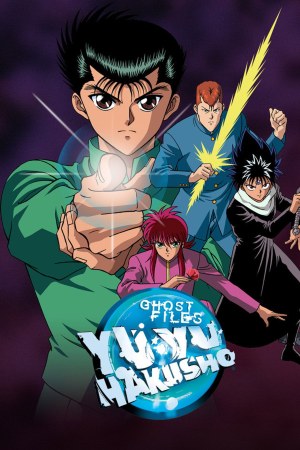
Yu Yu Hakusho

Yu Yu Hakusho

Yu Yu Hakusho: Ghost Files / 幽☆遊☆白書
1992 -1995 Studio Pierrot Fuji TV 112 episodes Completed
Action Adventure Supernatural Martial Arts
Details & Synopsis
Yusuke Urameshi begins Yu Yu Hakusho as the kind of teenager everyone has already written off. Then he dies saving a child from a car, surprising even the Spirit World, which had not expected him to do anything noble enough to earn an afterlife problem. Given a second chance, Yusuke returns as a Spirit Detective and is pulled into cases involving demons, stolen supernatural artifacts and threats crossing between the Human and Demon Worlds.

The series grows far beyond its opening ghost-story structure. Kuwabara goes from schoolyard rival to Yusuke's most dependable friend, while Kurama and Hiei move from dangerous opponents into the core team. Genkai's training gives Yusuke the discipline his raw power lacks, and the Dark Tournament turns that foundation into one of the defining tournament arcs of 1990s shonen anime. Later, the Chapter Black and Three Kings stories push the series into morally stranger territory and force Yusuke to confront what being human actually means to him.

For Western viewers, Yu Yu Hakusho became a bridge between generations of televised anime. FUNimation's English release reached Adult Swim in 2002 before moving to Toonami in 2003, introducing another long-running Japanese action series to the same audience that had already embraced Dragon Ball Z and would soon encounter Naruto and Bleach. The dub, the tournament fights, the character banter and the show's willingness to let its heroes be abrasive made it stick.

AnimeHistory covers Yu Yu Hakusho because it belongs directly in the lineage the archive is documenting. It is one of the major 1990s action series that helped define what a serialized anime could feel like for Western fans before the Big Three era arrived.
Alt Title Yu Yu Hakusho: Ghost Files / 幽☆遊☆白書
Studio Studio Pierrot
Network Fuji TV
Aired 1992 - 1995
Episodes 112
Genre Action, Adventure, Supernatural, Martial Arts
Status Completed

Fansub & Scanlation History

From Shōnen Jump to 112 Television Episodes

1990–1995 · Yoshihiro Togashi · Studio Pierrot

Yoshihiro Togashi began Yu Yu Hakusho in Weekly Shōnen Jump in 1990. Studio Pierrot’s television adaptation ran for 112 episodes in Japan from 1992 to 1995. English-speaking collectors encountered the show long before the full official American television run. Early subtitled tapes did not come from one continuous, unified team. They were assembled from different producers and physical distributors.

A Fansub Scene Before the American Broadcast

1990s · VHS circulation

By the late 1990s and early 2000s, collectors were documenting scattered Yu Yu Hakusho episode blocks on fan-subtitled videotape. The name on a cassette might belong to the translator, the duplicator, or simply the person who mailed the copy to a collector. The individual origins and dates of many tapes remain unresolved.

The First Television Tape Blocks

Several groups appear on surviving Yu Yu Hakusho tapes, sometimes with conflicting credits for the same episode blocks. The overlapping labels suggest that collectors weren't all watching an identical set of masters.

SilverWynd and the Opening Episodes

Episodes 1–16 · Collector credit

The Senshi Fansubs collection attributes episodes 1–12 to SilverWynd, with JDR Productions distributing that block, and separately attributes episodes 13–16 to SilverWynd. A surviving web-directory description says SilverWynd had been fansubbing since 1995, but that is a claim about the group’s beginning, not a verified date for these Yu Yu Hakusho tapes.

JDR's role was distribution; the surviving listing credits SilverWynd with the subtitles themselves.

Reality/Yagami, Sosamo and Scorpion

Episodes 17–36 · Competing tape credits

One collector inventory credits episodes 17–24 and 29–32 to Reality/Yagami Studios, 25–28 to Sosamo Anime, and 33–36 to Scorpion Anime. Soyokaze Fansubs appears as distributor for the 25–32 blocks. A separate Oldtaku catalog provisionally assigns 17–24 to SilverWynd and mentions a Sossamo remaster tied to 25–32. These may be different versions, remasters, or catalog errors. No tape comparison has settled the conflict.

Anime Densetsu no Kaitakusha

Episodes 51–58 · Collector attribution

Senshi’s tape list also credits Anime Densetsu no Kaitakusha on episodes 51–58. That eight-episode block is the portion preserved in this collector list; the group's full Yu Yu Hakusho output is still uncertain.

One Fansubber Remembers

The old catalogs name groups and episode ranges. One of the people behind those tapes has also described what the work was like.

Jason Salce and RYS Productions

Firsthand recollection posted January 22, 2024

Jason Salce, identifying himself as a co-founder of RYS Productions with his friend Matt, remembered trying to subtitle as many Yu Yu Hakusho episodes as he could while attending college. He also discussed helping establish the #fansubs channel on EFnet IRC. His recollection puts an actual college student and late nights of work behind the tapes. It doesn't give us a finished episode list for RYS.

A Viewer’s Incomplete Collection in 2001

October 30, 2001 · Fan document

A surviving fan-fiction document by Larissa A. Williams identifies the subtitled Yu Yu Hakusho episodes she had seen as 1–32, 55–58 and 73–76. She describes fansubbing groups working on different portions of the series at once. This is a snapshot of one viewer’s access, not a comprehensive list of all releases available that year.

Her account of what she had actually watched fits the patchwork of episode ranges in surviving VHS lists.

Trading Tapes Was Not Translating Them

A shop or club might list dozens of episodes by other subtitle teams.

The 2002 Distribution Directory

Sekihou Gumi · Himura Kenshin · Anything Goes · Aoiya

An early-2002 Yu Yu Hakusho fan-links directory advertised several tape suppliers: Sekihou Gumi listed episodes 32–112; Himura Kenshin Distribution, 56–112; Anything Goes Anime, 1–76; and Aoiya Fansub Distribution, 1–82. These services advertised tapes that fans could obtain, not necessarily episodes they had translated themselves. Another listing offered much of the series unsubtitled. A collector could assemble a remarkably broad run without any one group having subtitled it all.

What the VHS Marketplace Looked Like

Mail-order lists · Tape packages · Copies of copies

Some distributors sold or traded multi-tape packages. Fans chose from lists, mailed tapes or payment, and relied on the recording quality of the available copy. The same subtitle work could circulate under different distributor names, and a later collection could include revisions or tapes several generations removed from the master.

A service advertising episodes 32–112 was offering access to that stretch of the series, not claiming to have written subtitles for eighty-one episodes.

Funimation’s Rights Are Announced

January 10, 2001 · North American TV rights

AnimeNation reported Funimation’s acquisition of North American television rights after the VSDA/CES trade-show news in January 2001. In March, the outlet discussed tentative VHS and DVD plans for autumn, but proposed schedules should not be confused with what eventually shipped. The licensing news arrived while fan-subtitled tapes were still being assembled and traded.

From Adult Swim to Toonami

February 23, 2002 · March 2003

Yu Yu Hakusho debuted on American television through Adult Swim in February 2002. It moved to an edited Toonami presentation in March 2003. These commercial broadcasts brought the series to a much wider audience than the old club and mail-order tape circuit, but they did not erase the preceding fan-translation history.

A Different License for Each Screen

The two films and the Eizou Hakusho OVAs had their own subtitled tape histories, separate from the 112-episode television run.

The Two Films Reach American Video First

1998 · Separate distributors

The Golden Seal and Poltergeist Report reached North American home video in 1998, before Funimation’s television acquisition. Media Blasters/AnimeWorks handled the first film and Central Park Media/US Manga Corps handled the second. This explains why the earlier English movie dubs did not simply use Funimation’s later television cast.

Project Yuu Yuu and SilverWynd Movie Credits

VHS collector records · Dates unverified

A VHS collector catalog attributes a fan-subtitled copy of The Golden Seal to Project Yuu Yuu; another credits SilverWynd on the second movie. Neither tape list gives a confirmed original subtitling date. Both films circulated separately from the television episodes.

Eizou Hakusho Travels Separately

Japanese OVAs beginning 1994 · Later US DVD

Period fan links identified SilverWynd subtitle circulation for the Eizou Hakusho material. Funimation’s American DVD release arrived much later, in December 2011. The OVA compilation history belongs beside the TV fansub story, but cannot be merged into television episode totals.

English Manga Translations Before Shonen Jump

Early online text translation · Attribution incomplete

Inside Scanlation’s historical account identifies Yu Yu Hakusho among titles with early English manga translations online. The available evidence does not securely identify the first translating individual or group, the initial chapter date, or whether each early project used edited image scans rather than plain translation scripts. Their first translators have not been reliably identified.

Viz Brings the Manga into Print

2002 announcement · 2003 collected volume

Viz included Yu Yu Hakusho in the original American Shonen Jump lineup announced in 2002. The magazine launched in November 2002 with a January 2003 cover date. Viz’s first English collected volume followed in August 2003. That official publishing timeline is clearer than the identities behind the earlier online translation scripts.

The Record Is Fragmented, Not Empty

The surviving tapes, catalogs and recollections don't fit into one neat sequence, but together they trace a busy early English fansub scene.

Several Groups, No Single Master List

Attributions documented · Lineages unresolved

SilverWynd, Reality/Yagami, Sosamo, Scorpion Anime and Anime Densetsu no Kaitakusha appear on surviving tape collections. Jason Salce’s RYS account records another production participant. Distribution directories show audiences obtaining many more episodes from services that were not necessarily the translators. Disagreements between collectors may represent alternate versions, remasters, or errors; without comparing tapes, the precise relationships are unknown.

Yu Yu Hakusho reached English-speaking fans piece by piece, through different subtitlers and a patchwork of tape-trading networks. No single group's credits tell the whole story.