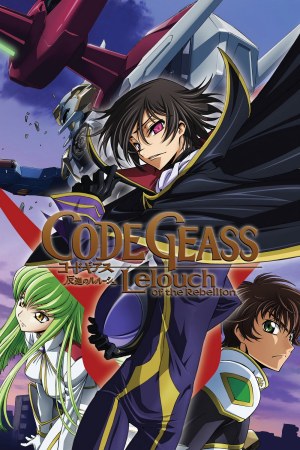
Code Geass

Code Geass

コードギアス 反逆のルルーシュ
2006 -2008 Sunrise MBS / TBS 50 episodes Completed
Action Mecha Sci-Fi Political Drama
Details & Synopsis
Lelouch vi Britannia is seventeenth in line to the throne of the Holy Britannian Empire, exiled to Japan, now called Area 11, a conquered territory with no rights and no name, following his mother's assassination and his sister's crippling. He attends school, plays chess for money, and waits.

Then a mysterious girl named C.C. gives him the Geass: the absolute power to command anyone to do anything, once, through direct eye contact. He puts on a mask. He calls himself Zero. He tells himself he is doing it to destroy Britannia.

He might even be right.

Produced by Sunrise and directed by Goro Taniguchi, who made s-CRY-ed five years earlier and clearly spent the intervening time thinking about political violence and what it costs, Code Geass: Lelouch of the Rebellion aired on MBS from 2006 to 2008. Fifty episodes across two seasons built around a chess match played in real time between a revolutionary who cannot stop lying and a childhood friend who joined the empire to reform it. The show understands that both positions are correct and neither of them will survive being correct.

The plot moves. This is the understatement of the decade. Code Geass was downloaded faster than most fansub groups could release it because no one watching it was willing to wait a week between episodes. The cliffhangers are not cheap, they are the load-bearing structure of a narrative that never stops accelerating. The Knightmare Frame battles are spectacular. The political maneuvering is genuinely intricate. The character work earns what it asks of you.

The ending of R2 is one of the most argued finales in anime history. It is also the correct ending. This is not up for debate.

Fifty episodes. Clear your schedule.
Alt Title コードギアス 反逆のルルーシュ
Studio Sunrise
Network MBS / TBS
Aired 2006 - 2008
Episodes 50
Genre Action, Mecha, Sci-Fi, Political Drama
Status Completed

Knightmare Frames & Tech

Sakuradite (High-Yield Superconductor)

Japan's Strategic Resource · More Than Mecha Fuel
Sakuradite is the strategic material behind much of Code Geass technology and one reason Japan matters enormously to the global balance of power. Mount Fuji's deposits make occupied Area 11 economically and militarily valuable to Britannia. The series uses the resource the way real empires use oil, shipping lanes, or rare minerals: technology and colonial policy are tied together.

Yggdrasil Drive & Factsphere Sensors

Power Core and Sensor System · Keep the Terms Separate
The Yggdrasil Drive is the compact power system at the heart of a Knightmare Frame, while Factspheres are sensor units used to gather visual and battlefield information. They belong to the same machine but do different jobs. The distinction matters because Code Geass mecha design is most interesting when the named parts explain what a pilot can actually do on screen, not when they are treated like decorative technical jargon.

4th & 5th Generation (Glasgow / Sutherland)

Glasgow to Sutherland · The Machines That Won Japan
Britannia's early Knightmare advantage changes warfare because a small, fast humanoid machine can move through cities and rough terrain in ways conventional armor cannot. The Glasgow helps establish that advantage during the conquest of Japan; the Sutherland becomes the familiar mass-production face of occupation. Their importance is not glamour but scale: these are the machines an empire can deploy everywhere.

7th Generation (Z-01 Lancelot & Guren Mk-II)

Lancelot and Guren · Two Sides of the Same War
The Lancelot and Guren Mk-II turn the political conflict into a recurring personal duel. Lloyd's Lancelot gives Suzaku extraordinary speed, defense, and precision; Rakshata's Guren gives Kallen the Radiant Wave Surger and a brutal close-range answer to Britannian armor. Their upgrades matter because each side keeps learning from the other, dragging the entire war into a technological arms race.

9th Generation Transcendent Frames

SPOILER! Albion and S.E.I.T.E.N. · Machines Outgrow Armies
The Lancelot Albion and Guren S.E.I.T.E.N. represent the point where elite Knightmares stop behaving like advanced units inside an army and start deciding entire sections of a battle by themselves. Energy Wings give both extreme aerial mobility and firepower. The final Suzaku-versus-Kallen duel works because the machines are near peers and the pilots have been chasing each other since the beginning.

Float System Units

Flight Changes the Battlefield
Float Systems free Knightmare Frames from the ground and turn battles that once depended on roads, buildings, and Landspinners into three-dimensional air combat. The important change is tactical rather than a fake engineering diagram: once elite machines can fly, positional advantages disappear faster, carriers matter more, and pilots like Suzaku and Kallen can cross a battlefield before conventional units can react.

Hadron Cannon

Gawain's Heavy Weapon · From Wild Beam to Precision Fire
The Hadron Cannon gives the Gawain the kind of long-range firepower that lets Lelouch affect a battle personally instead of only commanding it from the rear. Early use is difficult to control; Rakshata's work makes the weapon far more practical. Later machines inherit the idea, but the Gawain is where Lelouch's command platform first becomes a direct battlefield threat.

F.L.E.I.A. (Field Limit Expansion Implosion Armament)

SPOILER! F.L.E.I.A. · Deterrence Becomes Mass Erasure
Nina Einstein's F.L.E.I.A. warhead removes everything inside its expanding detonation field, making it fundamentally different from the ordinary explosions the series has used before. Suzaku's first launch over Tokyo turns a weapon developed as a strategic answer into an immediate civilian catastrophe. By the Damocles endgame, Schneizel's control of F.L.E.I.A. is political power: obedience can be demanded from entire nations at once.