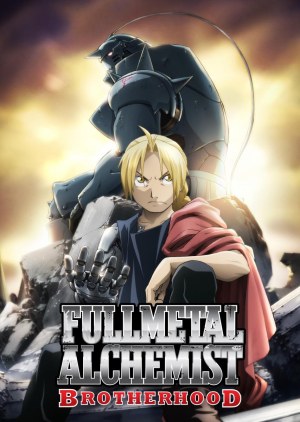
Fullmetal Alchemist: Brotherhood

Fullmetal Alchemist: Brotherhood

Hagane no Renkinjutsushi: Fullmetal Alchemist
2009 -2010 Bones MBS / TBS 64 episodes Completed
Action Adventure Drama Fantasy
Details & Synopsis
The 2003 series is the more interesting character study. Brotherhood is the better show. That tension is worth sitting with before you hit play, because Brotherhood earns its reputation the hard way, not by being darker or more surprising than its predecessor, but by being relentlessly, almost brutally well-constructed. The Elric brothers' original sin is established fast and the series never lets them, or you, forget it, even as the scale inflates from a single chimera in a country house to a conspiracy spanning an entire continent. What keeps it from collapsing under that weight is the same thing that saves all great shonen when it's working correctly: every political revelation lands hardest because of what it costs someone specific. No filler. Bone-dry pacing. Hiromu Arakawa's blueprint executed with a confidence that makes most other long-form adaptations look like they were guessing.
Alt Title Hagane no Renkinjutsushi: Fullmetal Alchemist
Studio Bones
Network MBS / TBS
Aired 2009 - 2010
Episodes 64
Genre Action, Adventure, Drama, Fantasy
Status Completed

Ishval & the War of Extermination

Ishval Is Not Backstory. It Is the Moral Center of the Military Plot

SPOILER!
Brotherhood introduces Ishval through Scar, military records and fragments of memory before finally showing the extermination in concentrated form. The point is not simply that Amestris committed an atrocity in the past. The officers driving the present-day story were shaped by what they did, witnessed or refused to do there.
Why it matters
The Promised Day is not only about stopping Father. For Mustang, Hawkeye, Armstrong and Scar, it is also about whether people produced by Ishval can build anything better than the state that created them.

A Shooting Becomes the Excuse for a War the State Was Ready to Use

SPOILER!
The murder of an Ishvalan child by an Amestrian soldier ignites open revolt, but Brotherhood gradually reveals that the conflict is useful to people far above the soldiers fighting it. Amestris does not merely respond to unrest. The war becomes another blood-soaked point in the nationwide design tied to Amestris itself as a transmutation circle.
What changed
Once the audience understands Father's plan, Ishval stops looking like an isolated historical disaster and becomes part of a national pattern.

Order 3066 Turns War Into Extermination

SPOILER!
King Bradley issues the order that changes the military objective from defeating an uprising to destroying the Ishvalan population. State Alchemists are deployed as human weapons because conventional attrition is no longer considered fast enough.
Why it matters
The title State Alchemist stops being an abstract badge of prestige. Ishval shows what the institution expects when the government decides an alchemist's research belongs on a battlefield.

State Alchemists Become the State's Shortcut

Mustang in Ishval: Obedience Before Reform

SPOILER!
Roy Mustang enters Ishval as a young State Alchemist who still believes rank can eventually give him the power to improve the country. The war forces him to confront the cost of waiting for authority while obeying the system that grants it.

He kills because he is ordered to kill, survives because he is exceptionally good at it and leaves Ishval convinced that merely being a better officer is not enough.
Why it matters
Mustang's ambition to become Führer is not presented as simple career hunger. Ishval is the reason he decides the chain of command itself has to change.

Hawkeye in Ishval: The Secret Behind Mustang's Flame Alchemy

SPOILER!
Riza Hawkeye arrives in Ishval carrying a history Mustang cannot separate from his own power. Her father encoded his flame-alchemy research on her back, and Mustang learned from that research.

After seeing what flame alchemy becomes in war, Hawkeye asks Mustang to burn the remaining array from her back so the complete research cannot be passed on again.
Why it matters
Their partnership is built on shared responsibility, not uncomplicated loyalty. Hawkeye supports Mustang's rise while also positioning herself as someone who must stop him if he becomes another leader who treats power as permission.

Armstrong Refuses the Logic of Extermination

SPOILER!
Alex Louis Armstrong reaches the point where he can no longer carry out the extermination order and breaks down rather than continue. The military removes him from the front.

That does not make him innocent. It makes his failure different from the officers who keep functioning by turning obedience into an excuse.
Why it matters
Brotherhood lets Armstrong's shame survive into the present. His compassion is not merely a personality trait; Ishval is the place where compassion made him militarily unreliable and morally human.

Kimblee Treats Ishval as Permission

SPOILER!
Solf J. Kimblee does not need the military to convince him that mass killing is necessary. Ishval gives him a sanctioned environment in which destruction is rewarded, and a Philosopher's Stone lets him push that destruction far beyond ordinary limits.
Why it matters
Kimblee is useful because he removes the comforting idea that every perpetrator is secretly horrified. Brotherhood places sincere remorse, rationalization, obedience and enthusiasm side by side.

Survival Does Not End the War

Scar's Brother Studies Both Sides of Alchemy

SPOILER!
Scar's brother researches Amestrian alchemy and Xingese alkahestry, eventually recognizing that Amestris has an artificial distortion built into its alchemical system.

His work produces two complementary arrays: one associated with destruction and another with reconstruction, plus the larger reverse array that can counter Father's interference.
Why it matters
Scar begins Brotherhood carrying only part of his brother's work. His character arc is literally incomplete until he accepts that destruction cannot be the only half he uses.

Scar Receives the Arm He Spends the Series Learning How to Use

SPOILER!
Kimblee's attack leaves Scar gravely wounded. Scar's brother gives up his own arm to save him, leaving Scar with the tattooed destruction array that becomes his signature weapon.

For much of the series Scar uses that inherited power as if its meaning were obvious: Amestrian alchemy destroyed Ishval, so he will use alchemy to destroy the people responsible.
What changed
Learning the rest of his brother's research eventually turns the arm from an instrument of revenge into one part of a larger act of restoration.

The Rockbells Make Scar's Revenge Impossible to Keep Clean

SPOILER!
Winry's parents treat wounded Ishvalans despite being Amestrian civilians. Scar, delirious after losing his brother, kills them after awakening in their care.

The revelation does not erase what Amestris did to Ishval, and Brotherhood does not use the Rockbells to flatten the war into 'both sides were equally wrong.' It makes Scar confront something narrower and harder: being a victim of state violence does not make every act of revenge just.
Why it matters
Winry and Scar force the story to separate justice from repetition.

Miles Shows an Ishvalan Can Remain Inside the Military Without Calling It Innocent

SPOILER!
Major Miles serves at Briggs while openly carrying Ishvalan ancestry. Olivier Armstrong values his competence and refuses the racial logic that helped justify the extermination.

Miles does not pretend Amestris has made amends. His position shows a different survival strategy from Scar's: remain inside the structure, gain leverage and make future decisions harder for the old ideology to reproduce.
Why it matters
Brotherhood gives Ishvalan survival more than one political answer.
The War Keeps Operating in the Present

Marcoh's Research Connects Ishval to the Philosopher's Stone

SPOILER!
Tim Marcoh's work reveals that the military's interest in Ishval extends beyond conquest. Human lives can be processed into Philosopher's Stones, turning a civilian population into a resource for alchemical power.
Why it matters
The Stone stops being a legendary object disconnected from politics. Amestris has institutions capable of creating it because the state has already normalized treating populations as material.

Scar Chooses Reconstruction on the Promised Day

SPOILER!
By the Promised Day, Scar has added his brother's reconstruction array to his other arm and accepted cooperation with people he once would have treated only as enemies.

He activates his brother's reverse transmutation circle, removing Father's suppression of Amestrian alchemy and giving the country's alchemists access to the power they thought they had always been using.
What changed
Scar does not abandon Ishval or forgive the state. He stops letting the state decide that destruction is the only language available to him.