
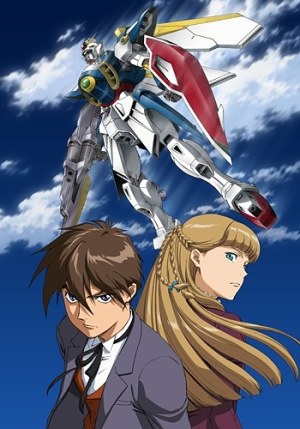
Mobile Suit Gundam Wing

Mobile Suit Gundam Wing

新機動戦記ガンダムW
1995 -1996 Sunrise TV Asahi 49 episodes Completed
Action Mecha Sci-Fi Political Drama
Details & Synopsis
After Colony 195. The colonies have had enough of the United Earth Sphere Alliance, so five teenage pilots are sent to Earth in five Gundams as part of Operation Meteor. Heero Yuy, Duo Maxwell, Trowa Barton, Quatre Raberba Winner, and Chang Wufei arrive separately, barely understand the plan, and spend much of the series fighting the same war from five different directions.

Gundam Wing was not the first Gundam series, not the cleanest Gundam series, and definitely not the easiest political plot to explain after missing an episode. It was the one Toonami aired in 2000, which made it the first Gundam for an entire generation of North American viewers. That matters more than any argument about where it ranks now. Wing put mobile suits, colony politics, masked rivals, tragic child soldiers, and Relena Peacecraft on television after school and trusted kids to keep up.

The dub became part of the memory. So did the edited daytime broadcast, the uncut late-night airing, the model kits, and Endless Waltz showing up later with redesigned Gundams that looked impossible and immediately became the versions everyone wanted. You did not need to know Universal Century continuity. You needed to know that Duo called himself the God of Death and Heero could survive almost anything except a normal conversation.

Forty-nine episodes of beautiful boys making catastrophic military decisions. It worked.
Alt Title 新機動戦記ガンダムW
Studio Sunrise
Network TV Asahi
Aired 1995 - 1996
Episodes 49
Genre Action, Mecha, Sci-Fi, Political Drama
Status Completed

Gundam Engineering & Design Logic

Tallgeese Is the Common Ancestor Behind the Gundams

Five engineers · an earlier prototype · five later design philosophies

The scientists later responsible for the Operation Meteor Gundams had also been involved with the much earlier Tallgeese project.

Tallgeese demonstrated how far mobile-suit performance could be pushed, but it also demanded a pilot capable of surviving that performance.
Why it matters
The five Gundams are easier to understand as different answers to the same basic problem. Instead of building five identical machines, the engineers take extreme mobile-suit performance in five different directions.

Gundanium Alloy Is Why the Five Gundams Can Fight Armies

Colony-produced armor · exceptional strength for its weight

The five Operation Meteor machines are built with Gundanium alloy produced in space.

The material gives the Gundams an enormous defensive advantage over ordinary Alliance and OZ mobile suits while still allowing machines designed for speed, flight or close combat.
Why it matters
The pilots survive attacks that would destroy conventional suits because their machines are not merely better armed. They are built from a material the armies on Earth cannot casually match.

Doctor J Builds Around Flight and the Buster Rifle

Wing Gundam · transformation · high-impact ranged attacks

Doctor J's Wing Gundam combines a transformable flight mode with the Buster Rifle's enormous ranged power.

The result suits Heero's early missions: reach a target quickly, strike military infrastructure hard and leave conventional defenders trying to catch a machine they were never equipped to fight.
Why it matters
The design is not simply 'the balanced Gundam.' Wing's identity is mobility plus a small number of attacks powerful enough to change a battle immediately.

Professor G Builds Around Stealth and Close-Range Ambush

Deathscythe · jamming · beam scythe

Professor G's Deathscythe combines battlefield jamming with a weapon that becomes most dangerous at close range.
Why it matters
The machine's systems all support the same idea. Duo does not need Deathscythe to win a long exchange of fire if the enemy cannot track him properly before he reaches scythe range.

Doktor S Builds Heavyarms Around Stored Firepower

Gatling guns · missiles · finite ammunition

Doktor S's Heavyarms carries its attack power directly on the machine in layers of guns and missile launchers.

That gives Trowa overwhelming opening firepower but also creates a visible limitation: ammunition can run out.
Why it matters
Heavyarms' design gives its battles a rhythm the other Gundams do not have. Trowa can erase conventional units under a storm of fire and still be forced into close combat when the magazines are empty.

Instructor H Builds Sandrock Around Durability and Fighting With Others

Heavy armor · heat shotels · Maganac partnership

Instructor H's Sandrock is heavily armored and centered on close combat with paired heat shotels.

What separates it most clearly in the series is context: Quatre arrives with the Maganac Corps already willing to fight beside him.
Why it matters
Sandrock fits a pilot who is unusually comfortable treating battle as a group responsibility. Its identity comes as much from Quatre's place among allies as from a list of hardware.

Master O Builds Shenlong Around Direct Close Combat

Dragon Fang · beam glaive · Wufei's dueling style

Master O's Shenlong emphasizes reach and close-range striking through the Dragon Fang and beam glaive.
Why it matters
The design matches Wufei's tendency to turn warfare into personal tests of strength and justice. Shenlong gives him a machine that feels most natural when the distance between opponents disappears.