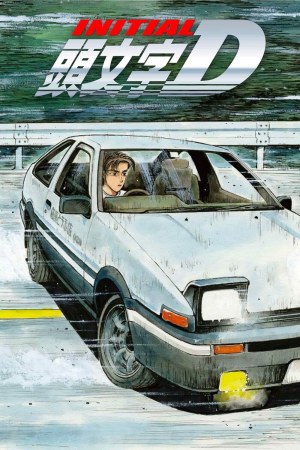
Initial D

Initial D

イニシャルD
1998 Studio Comet Fuji TV 26 episodes Completed
Racing Sports Drama Action
Details & Synopsis
Takumi Fujiwara delivers tofu. Every morning, before school, before the world wakes up, he drives his father's beat-up AE86 Trueno up and down Mount Akina at speeds that should be impossible for a car that old, on roads that should be impossible for anyone. He does not know he is good. He does not care. He is half-asleep and thinking about nothing.

Then the racing teams start showing up.

Based on Shuichi Shigeno's manga and produced by Studio Comet, Initial D First Stage aired on Fuji TV in 1998. Twenty-six episodes of touge street racing, mountain pass battles between purpose-built machines and one kid in a forty-horsepower hatchback who learned to drive by hauling bean curd. The CGI used for the racing sequences was primitive even by 1998 standards. It does not matter. The physics, the technique, the specific language of downhill racing, heel-toe braking, the gutter dip, the blind attack, are rendered with an obsessive authenticity that had actual car enthusiasts sitting down to watch anime for the first time in their lives.

The soundtrack is Eurobeat. This is not ironic. The Eurobeat is correct. It has always been correct.

Initial D built a fansub community that existed in parallel to the mainstream anime scene, car forums and racing enthusiasts who didn't know who Toonami was but had downloaded every episode by the time Second Stage dropped. That crossover is the story. A show that found an entirely different audience through entirely different channels and brought them into the same space everyone else was already in.

Twenty-six episodes for First Stage. Second Stage, Third Stage, Fourth Stage, Final Stage, the full arc covers Takumi's entire competitive career. Start here. You will not stop.
Alt Title イニシャルD
Studio Studio Comet
Network Fuji TV
Aired 1998
Episodes 26
Genre Racing, Sports, Drama, Action
Status Completed

Cars & Driving Technique

Initial D Is Not a Horsepower Ladder

SPOILER!
First Stage repeatedly puts Takumi in an older, less powerful car against machinery that looks better on paper.

The point is not that horsepower is fake. It is that a mountain road gives power, weight, tires, gearing, braking, line choice and driver familiarity different chances to matter.
Why it matters
The races are easiest to understand when the car and driver are treated as one package. A faster car can still lose if its advantage cannot be used where the road is asking a different question.

Every Rival Car Represents a Different Way to Be Fast

Toyota AE86 Trueno: Familiarity Is Takumi's Real Upgrade

SPOILER!
Takumi's AE86 is old enough to look unimpressive beside the RedSuns and NightKids cars, but he has driven the Akina delivery route for years before anybody tells him to think of it as racing.
Why it matters
The 86 is not secretly unbeatable. Its greatest First Stage advantage is that Takumi knows exactly how it moves on the road where most of his important battles happen.

Keisuke's RX-7 FD3S: Power Has to Survive the Corners

SPOILER!
Keisuke's FD3S gives him the acceleration and performance expected from a serious RedSuns car. Against ordinary local racers, that is overwhelming.

Takumi's first formal battle forces Keisuke to discover that straight-line advantage does not automatically settle a downhill full of linked corners.
Why it matters
Keisuke is the first person in the series to learn that the AE86's threat is not the car's reputation. It is the driver using every part of Akina better than he does.

Ryosuke's RX-7 FC3S: Balance Before Bragging Rights

SPOILER!
Ryosuke treats his FC as part of a larger theory about repeatable speed. He studies opponents, adjusts the car and thinks about what the course will demand rather than chasing the biggest possible number.
Why it matters
His final battle with Takumi feels different from Keisuke's because Ryosuke is trying to solve Takumi, not merely outrun him.

Nakazato's R32 GT-R: Grip, Weight and Tire Load

SPOILER!
Nakazato trusts the R32 GT-R's traction and power and rejects drifting as wasted motion. On Akina, that confidence becomes a test of how hard a heavy, powerful car can be pushed through repeated downhill corners before the front tires stop giving him what he expects.
Why it matters
The race does not say grip is bad. It shows that even a grip-focused strategy has a limit when the driver keeps increasing the demand on the same tires.

Shingo's Civic EG6: Front-Wheel Drive Changes the Tape Match

SPOILER!
Shingo chooses a right-hand gum-tape deathmatch knowing that restricted steering punishes the normal corrections Takumi relies on.

His front-wheel-drive Civic behaves differently from Takumi's rear-wheel-drive AE86, and Shingo has built his challenge around a format he understands.
Why it matters
The danger is not a random gimmick. Shingo is trying to make the rules of the race part of his car advantage.

Impact Blue's SilEighty: The Car Is a Two-Person System

SPOILER!
Mako drives while Sayuki reads the road, calls information and helps maintain the rhythm of a course they know intimately.
Why it matters
The SilEighty battle is the first time Takumi faces an opponent whose home-course knowledge is organized between two people. He is not only chasing a car; he is chasing a practiced partnership.

Itsuki's AE85: Looking Like an Eight-Six Is Not Being an Eight-Six

SPOILER!
Itsuki buys an AE85 Levin believing he has found the car he has dreamed about, only to discover that the badge and mechanical package are not what he thought he was buying.

Takumi later drives it fast enough to humiliate racers who had mocked Itsuki.
Why it matters
The joke works in both directions. The wrong model really is less capable, but driver skill still matters enough to expose people who think the badge settles everything.

The Techniques Are Exaggerated, but They Usually Have a Job

Weight Transfer Is the Foundation Under the Flashy Stuff

SPOILER!
Takumi's smoothness comes from changing the load on the car without upsetting it more than necessary. Braking, throttle and steering all shift weight between the tires, changing how much grip each end of the car can use.
Why it matters
The drifts get the posters. Weight transfer is the reason Takumi can enter them, correct them and leave them without looking as busy as the people chasing him.

The Cup of Water Rewards Smooth Inputs, Not Magic

SPOILER!
Bunta's water-cup rule punishes abrupt acceleration, braking and cornering because sudden movement sends the water out of the cup.

The exercise turns an ordinary delivery requirement into a constant lesson in smooth vehicle control.
Why it matters
Takumi learns the feel of the car before he learns the vocabulary racers use to describe what he is doing.

The Gutter Run Is a Line Choice Built Around One Specific Road Feature

SPOILER!
At Akina's five consecutive hairpins, Takumi places the inside wheels into the drainage channel so the car can hold a tighter path through the corner.
How you can tell
It only makes sense where the road provides the right gutter. That is why it feels like an Akina technique rather than a universal button Takumi can press on every mountain.

Tire Management Is Often the Hidden Race Clock

SPOILER!
A driver can be faster early and still lose if the tires are being asked to do too much for too long. First Stage repeatedly uses fading front-end grip and overheated tires to explain why a race changes late.
Why it matters
This is why Ryosuke spends so much time watching lines and predicting what another car will do several corners later. The race is happening to the tires even when the camera is focused on the drivers.

Home-Course Knowledge Is Thousands of Tiny Decisions

SPOILER!
Takumi's Akina advantage is not simply knowing which direction the next corner turns. Repetition teaches braking points, road width, camber changes, linked corners and where the car can be placed without wasting motion.
Why it matters
When Takumi goes to Usui, the series finally removes the advantage that has been hiding underneath his natural talent.

Rain Punishes Suddenness

SPOILER!
Wet pavement reduces the margin available for acceleration, braking and cornering. The driver who makes abrupt demands is more likely to run out of grip.
Why it matters
Takumi's years of smooth delivery driving become especially valuable in the rain because the same habits that protected tofu also keep the car settled when the road offers less traction.

Myth: Initial D Says Drifting Is Always the Fastest Technique

SPOILER!

The anime treats technique as situational

The series loves drifting visually, but its races repeatedly distinguish between style and whatever line, grip level or rotation the current corner actually needs.

Nakazato's mistake is not that he believes in grip. Shingo's advantage is not that front-wheel drive is automatically superior. Takumi wins by adapting rather than obeying one doctrine.
Why it matters
Initial D is much more interesting when the races are read as competing solutions instead of one universal 'drift beats grip' rule.