
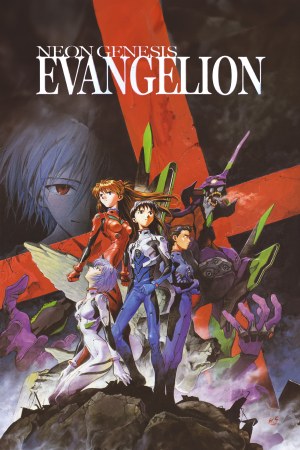
Neon Genesis Evangelion

Neon Genesis Evangelion

新世紀エヴァンゲリオン
1995 -1996 Gainax / Tatsunoko Production TV Tokyo 26 episodes Completed
Action Mecha Psychological Drama
Details & Synopsis
The year is 2015. Fifteen years after a cataclysm that killed half the human race, the city of Tokyo-3 is under attack from beings called Angels, massive, incomprehensible, and apparently unkillable by conventional means. The only things that can stop them are the Evangelions: giant biomechanical units that can only be piloted by children born in the aftermath of the disaster. Shinji Ikari is fourteen years old. His father, commander of the paramilitary organization NERV, has not spoken to him in years. He is asked to climb inside the Eva and save the world. He does not want to.

Produced by Gainax and directed by Hideaki Anno, who made the series as a working through of his own four-year clinical depression, Neon Genesis Evangelion aired on TV Tokyo from October 1995 to March 1996. It begins as a mecha action series and becomes, by its end, something else entirely: a deconstruction of heroism, identity, and the terror of human connection so thorough it broke the genre it was working in.

26 episodes. The last two will make you feel insane. Watch The End of Evangelion immediately after. Then sit quietly for a while.

Gainax went bankrupt in 2024. The series endures.
Alt Title 新世紀エヴァンゲリオン
Studio Gainax / Tatsunoko Production
Network TV Tokyo
Aired 1995 - 1996
Episodes 26
Genre Action, Mecha, Psychological, Drama
Status Completed

Angel Threat Registry

1st Angel: Adam

SPOILER! First Angel · Second Impact
Adam is identified by NERV and SEELE as the First Angel and is central to the hidden history of Second Impact. The Katsuragi Expedition's contact experiment in Antarctica reduced Adam to an embryonic state after the catastrophe.

Kaji later delivers that embryo to Gendo. The television series deliberately withholds several details about what Gendo ultimately does with it; later material makes some of those details explicit.
Why it matters
For much of the series the characters, and the audience, are encouraged to assume that the giant beneath NERV is Adam. Episode 24 reveals that assumption is wrong.

2nd Angel: Lilith

SPOILER! Second Angel · Terminal Dogma
Lilith is the enormous being crucified in Terminal Dogma beneath NERV Headquarters. For much of the television series, characters outside the deepest conspiracy believe the being below NERV is Adam. Kaworu identifies it as Lilith in episode 24.

Lilith is tied to Rei and to humanity in ways the television ending approaches symbolically and the later film continuation makes more physically explicit.
Why it matters
The Adam/Lilith reveal is one of Evangelion's central perspective shifts. NERV has not merely been hiding information from the public; different layers of the organization are operating with different understandings of what is beneath them.

3rd Angel: Sachiel

First Tokyo-3 Battle · Unit-01 Awakens
Sachiel is the first Angel to attack Tokyo-3 during the series. Conventional military weapons fail to stop it, forcing NERV to put an untrained Shinji into Unit-01.

Shinji loses control of the fight, but Unit-01 rises and acts on its own, tears through Sachiel's defenses and survives the Angel's final self-destructive attack.
Why it matters
The first battle immediately tells the viewer that an Evangelion is not behaving like an ordinary machine. Shinji is the pilot, but he is not the only will inside Unit-01.

5th Angel: Ramiel

Operation Yashima · Long-Range Siege
Ramiel attacks from above Tokyo-3 with a powerful beam and begins drilling toward NERV Headquarters. Its A.T. Field makes a normal close-range Eva assault impractical.

Operation Yashima turns the entire Japanese electrical grid into support for a positron rifle shot while Rei protects Shinji long enough for him to fire again after the first attempt fails.
Why it matters
This is the first battle where NERV wins through planning, infrastructure and trust between pilots rather than through Unit-01 losing control.

10th Angel: Sahaquiel

Orbital Assault · Three-Eva Interception
Sahaquiel attacks from orbit by dropping portions of itself and then committing its full body to a collision with Tokyo-3. Misato's answer is not a special weapon. She sends all three Evangelions sprinting to catch it before impact.
Why it matters
The battle is one of the series' clearest demonstrations that Shinji, Rei and Asuka can function as a team. That matters because the second half of Evangelion systematically dismantles that temporary stability.

14th Angel: Zeruel

SPOILER! NERV Breach · Unit-01 Changes
Zeruel tears through NERV's defenses, defeats Asuka and Rei and reaches deep into Headquarters before Shinji returns to Unit-01.

When Unit-01 runs out of external power, it awakens again, destroys Zeruel and consumes part of the Angel. NERV later identifies this as Unit-01 acquiring an S² Engine.
Why it matters
After Zeruel, Unit-01 is no longer merely NERV's strongest Eva. It has demonstrated autonomous behavior, acquired an Angel-like power source and become something both Gendo and SEELE treat as central to their endgames.

15th & 16th Angels: Arael & Armisael

SPOILER! Psychological Assault · Direct Contact
Arael attacks Asuka from orbit by forcing unwanted psychological contact, exposing memories and fears she has built her identity around refusing to show. The attack accelerates a synchronization collapse already underway.

Armisael takes the opposite route with Rei: direct physical and psychological fusion. Rei ultimately destroys Unit-00 and herself to stop the Angel from reaching Shinji.
Why it matters
The late Angels stop testing only armor and weapons. They attack the pilots' identities, making the boundary between combat and psychological exposure disappear.

17th Angel: Tabris (Kaworu Nagisa)

SPOILER! Final Angel · Fifth Child
Kaworu Nagisa arrives as the Fifth Child and is revealed to be Tabris, the final Angel encountered in the television series. He can synchronize with Unit-02 without entering it and deploy an A.T. Field powerful enough to cut NERV off from Terminal Dogma.

Kaworu descends believing the being below NERV is Adam, then recognizes that the crucified giant is actually Lilith. Rather than continue toward a result that would destroy humanity, he asks Shinji to kill him.
Why it matters
Episode 24 turns the Angel conflict into a choice rather than another battle. Kaworu is both the enemy NERV has been waiting for and the first person to offer Shinji acceptance without demanding performance in return.

18th Angel: Lilin (Mankind)

SPOILER! Humanity · The Lilin
Kaworu calls humanity "Lilin," connecting human beings to Lilith rather than to Adam's line of Angels. The television series uses the term to reframe the conflict: the creatures NERV calls Angels are not simply invaders attacking an unrelated species.

The later film continuation makes the "humanity as the final Angel" framing more explicit than episodes 1–26 do.
Why it matters
By the end of the series, the boundary between "human" and "Angel" is much less comfortable than it was in episode 1. The conflict is about competing forms of life and the barriers that keep individual beings separate.