Dragon Ball

Dragon Ball

ドラゴンボール
1986 -1989 Toei Animation Fuji TV 153 episodes Completed
Action Adventure Comedy Martial Arts
Details & Synopsis
Before the Saiyans. Before Namek. Before power levels meant anything at all, there was a kid with a tail, a talking pig, and a treasure hunt.
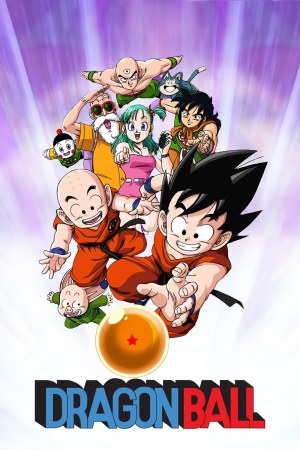
Son Goku is not the hero yet. He is a wild child raised alone in the mountains, strong enough to punch through boulders and naive enough to think Bulma's bra is some kind of helmet. When Bulma shows up hunting the seven Dragon Balls, Goku tags along, and what starts as a road trip comedy slowly, patiently, becomes the blueprint every shonen series after it would spend decades copying.
Produced by Toei Animation from Akira Toriyama's manga, Dragon Ball aired on Fuji TV from 1986 to 1989. 153 episodes that build Goku from a feral kid who has never seen a car into a genuine martial artist under Master Roshi's training, through two World Martial Arts Tournaments that establish the cast, Krillin, Yamcha, Tien, Chiaotzu, who would carry the entire back half of the franchise. Then Piccolo Daimao arrives, and the show that started as slapstick adventure comedy pivots into something considerably darker, ending on a cliffhanger that walks directly into the story everyone actually remembers.
This is the part people skip. That is a mistake. Every rule Dragon Ball Z would spend 291 episodes escalating, the tournaments, the training arcs, the villain who turns ally, the power that comes from pushing past your limit, gets written here first, at a fraction of the stakes and twice the charm. Goku punching a dinosaur because he is hungry. The Kamehameha as a discovery, not a signature move yet. Before he was the strongest fighter in the universe, he was just a kid who wanted to eat.
Watch this first. Or watch it after Z, once you already love him, and see where all of it actually started.
Alt Title ドラゴンボール
Studio Toei Animation
Network Fuji TV
Aired 1986 - 1989
Episodes 153
Genre Action, Adventure, Comedy, Martial Arts
Status Completed

Fansub & Scanlation History

A Handful of People, Racing to Translate Faster Than Viz Would Move

Real Licensing-Honor Stories, Unlike the Anime Side

The Daily Dragon Ball Chapters

1997–2000 · Fanscan 101 · Contributor Network · Free-Host Mirrors

The Daily Dragon Ball Chapters left behind something better than a retrospective history: its own work log. The surviving updates show chapters arriving constantly through 1997 and 1998, with individual work credited to people such as Spamdini, Piccolo Z and DBZ 3:16/Michael Harris. DDBC was not just one person uploading a finished archive. It became a small collaborative fanscanning hub.

Its Fanscan 101 page even preserves the period vocabulary and workflow. The site calls the practice fanscanning, recommends a flatbed scanner and an image editor such as Paint Shop Pro, suggests 150–200 DPI, uses GIF for black-and-white line art and JPEG for greyscale pages, then describes erasing the original text and inserting the English translation manually. Outside fanscanners were invited to send chapters in for hosting.

The infrastructure was just as 1998 as the technique. DDBC repeatedly asked readers for spare GeoCities accounts because FTP trouble, dead links and tiny hosting quotas could knock whole runs offline.
Why it matters
This is a surviving production diary for pre-standardized scanlation. It also documents the licensing code in practice: when Viz scheduled Dragon Ball material for official publication, DDBC removed those chapters and told readers to buy the issues instead.

Joseph Teed, Peter Michaud & the Translated DBZ Manga Page

December 1997 · ZIPped GIF/JPG Chapters · Mixed Translation Credits

Joseph Teed's 1997 DragonBall Z Manga in English page is almost a diagram of how loose the early fanscan pipeline could be. Teed maintained the site. The page says Peter Michaud was the person who scanned the manga and changed the text, while Anime Crisis provided translations. Then the chapter table for 289–296 labels Peter himself as the translator.

Peter's own later page makes the overlap easier to understand. Pete's Translated Dragonball links back to Joseph Teed for Peter's other scans, hosts completed chapters 297–302, separately lists text-only translations for 305–307, and says Peter's translations were going on hold while he translated a DBZ OVA for Chris Shepard. Scanner, editor, translator and host were roles, not permanent identities.

The licensing transition is just as direct. Teed says the site existed because DBZ manga was not available in the United States. Once Viz was preparing an official release, he wrote that the problem had effectively been solved and that the page would probably come down once publication actually began.
The Breakdown
Calling this one neat scanlation group hides the interesting part. It was a small translation network whose labor and scripts crossed between people and sites.

This Is Where "Honored the Code" Actually Applies

Unlike the anime release history on this page, where DBZ was already licensed before any of it started, the manga scene genuinely lived through a licensing moment. Both Doyama's Dragon Ball Project and the Translated DBZ Manga Page shut down specifically because Viz picked up the license, real instances of groups stepping aside rather than continuing to run.

NGN Covered a Large Stretch of the Original Run

NGN, a real VHS-era group, covered a large stretch of the original Dragon Ball run, confirmed via a physical fansub VHS collector/trader documentation source.

Project X, Confirmed by a February 2001 Trade Catalog

Project X, a real VHS-era fansub group, covered nearly the entire early Dragon Ball GT run, episodes 3 through 47 across multiple listed ranges, confirmed via an archived trade catalog dated February 11, 2001.

The Dragon Ball Project

1996–1997 · Smurfbob + Jason Doyama · Contemporary term: Fan Lettering

The surviving Dragon Ball Project page finally gives us the workflow in the project's own words. The page was created by Smurfbob, who says he took Japanese Dragon Ball graphic novels, scanned the pages into his computer, got translations from Jason Doyama, and put the English directly onto the manga pages. The page's own term for the work was "fan lettering."

That also corrects an older version of this Lore entry. The surviving project is not a pre-1992 Usenet/FTP operation. Its update trail is active in 1996 and 1997, right in the first wave of web-based Dragon Ball manga sharing.
Why it matters
This is what scanlation looked like before the scene standardized the word scanlation. Translation, scanning and lettering could be separate jobs, and a tiny web project could assemble them into readable English manga one page at a time. When Viz announced US publication, the project declared itself dead and said it would stop fan lettering Dragon Ball rather than compete with the official release.

Same Fight as Z, Smaller Show, Just as Stubborn

One Hundred Fifty-Three Episodes, Dozens of Attempts

The Dropped-Attempt Tail

The same pattern that defined DBZ's release history shows up here too, dozens of groups started a complete 153-episode uncut run between 2004 and the late 2010s, and most never finished. dbzsubbed, DBX, ADemons, DBZ-Crew, oot.clan, ThePhoenix Team, AoZ, RaX, PUNCH, more than a dozen others, all stalled or dropped somewhere short of episode 153.

Quality Doesn't Always Mean Finishing

Two of the highest-rated releases in the entire archive never made it past episode 13: G-A hit an 8.60 rating on just 11 episodes before dropping, and Rabbit-Force pulled a 7.89 across 20 votes on 13 episodes before the same fate. THE BREAKDOWN: the best work on this list and the completed work on this list are not the same list. Both things can be true about a fan project at once, genuinely excellent, and still unfinished.

Utsukushii-Raws

Complete, May 2013
The release most worth pointing someone toward if they want the real, unedited original Dragon Ball. All 153 episodes, DVD-sourced, and rated well above every other complete release on record.

Anime-Supreme and DBNL Finished It Too

Both groups that led DBZ's complete-release history did the same job here: Anime-Supreme finished in February 2009 with the widest vote count of any complete release on the list, and DBNL followed in August 2010. Same two names, same commitment, second show.

Still Going, Literally This Month

The Same Ledger DBZ Landed On

iKaos-SoM, February 2025 & SoM, June 2026

The same modern lineage that closed out DBZ's page shows up here too, iKaos-SoM completing a full 153-episode run in early 2025, and this site's own SoM release landing complete on the archive just last month. Same twenty-year fight, same two shows, same release finally carrying it forward.

Firesoul64 Is Still Working On It Right Now

As of the most recent archive entry, a group called Firesoul64 is actively releasing an uncut original Dragon Ball run, 28 episodes in as of this month.
The Breakdown
this page isn't a closed history. Someone, right now, in real time, is still doing the exact work this whole page is about.

When Dragon Ball Finally Became an Official English-Language Product

1989–2010 · Failed Starts, Syndication, Manga Licensing & Complete Home Video

Harmony Gold's Abandoned 1989 English Localization

Five Television Episodes · One Composite Feature · Renamed Cast

Dragon Ball's first known English-language television localization was attempted by Harmony Gold in 1989. Five television episodes were dubbed, and material from the first and third theatrical films was combined into a feature-length presentation. The adaptation heavily renamed the cast, including Goku as Zero, Bulma as Lena and Kuririn as Bongo. The project did not develop into a continuing North American series, leaving the surviving recordings as an unusual pre-Funimation branch of Dragon Ball's English-language history.

Funimation's First Syndicated Run Stopped After Thirteen Episodes

1995 Broadcast Attempt · Edited Television Version · Later VHS Release

Funimation made its first attempt to establish the original Dragon Ball on American television in 1995. Working with outside production and distribution partners, it prepared an edited English-language version for first-run syndication. Only thirteen television episodes were completed for that run before the effort ended. Those episodes, along with a separately localized version of the first Dragon Ball film, later circulated on North American home video. It was an official release, but not yet the complete-series treatment fans had been waiting for.

Viz Brought the Manga Into Regular North American Publication

1998 Serialization · Dragon Ball / Dragon Ball Z Branding Split

Viz began publishing Akira Toriyama's manga in North America in 1998, first through serialized comic-book issues and later collected editions. Although the Japanese manga ran continuously under the Dragon Ball title, Viz marketed the childhood portion as Dragon Ball and the later portion as Dragon Ball Z. Early editions were also reformatted for left-to-right reading before later releases restored the original right-to-left page orientation. This official publication did not erase the earlier fan-translation history, but it changed the role unofficial copies played for English-language readers.

The Complete Series Finally Reached the Official English Market

2001 Television Return · 2009–2010 Complete Uncut DVD Seasons
After Dragon Ball Z became an established television success, Funimation returned to the original series with a new English dub. Dragon Ball joined Cartoon Network's Toonami schedule in 2001, and Funimation continued beyond the thirteen episodes covered by its earlier attempt. North American home-video rights surrounding those first episodes delayed a single uniform complete release, but Funimation ultimately issued all 153 episodes across five uncut DVD season sets between September 2009 and July 2010. By that point, the complete television series was commercially available in English, even as fan releases continued competing on translation choices, source quality, restoration and presentation.