
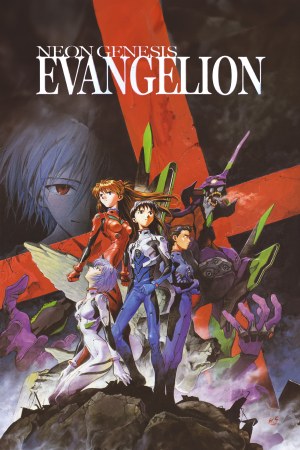
Neon Genesis Evangelion

Neon Genesis Evangelion

新世紀エヴァンゲリオン
1995 -1996 Gainax / Tatsunoko Production TV Tokyo 26 episodes Completed
Action Mecha Psychological Drama
Details & Synopsis
The year is 2015. Fifteen years after a cataclysm that killed half the human race, the city of Tokyo-3 is under attack from beings called Angels, massive, incomprehensible, and apparently unkillable by conventional means. The only things that can stop them are the Evangelions: giant biomechanical units that can only be piloted by children born in the aftermath of the disaster. Shinji Ikari is fourteen years old. His father, commander of the paramilitary organization NERV, has not spoken to him in years. He is asked to climb inside the Eva and save the world. He does not want to.

Produced by Gainax and directed by Hideaki Anno, who made the series as a working through of his own four-year clinical depression, Neon Genesis Evangelion aired on TV Tokyo from October 1995 to March 1996. It begins as a mecha action series and becomes, by its end, something else entirely: a deconstruction of heroism, identity, and the terror of human connection so thorough it broke the genre it was working in.

26 episodes. The last two will make you feel insane. Watch The End of Evangelion immediately after. Then sit quietly for a while.

Gainax went bankrupt in 2024. The series endures.
Alt Title 新世紀エヴァンゲリオン
Studio Gainax / Tatsunoko Production
Network TV Tokyo
Aired 1995 - 1996
Episodes 26
Genre Action, Mecha, Psychological, Drama
Status Completed

Rei, Adam, Lilith & Kaworu

The Four Names Viewers Are Most Likely to Mix Up

SPOILER!
Rei, Adam, Lilith and Kaworu are connected, but they are not interchangeable pieces of one identity.

Adam is the First Angel and the being tied to Second Impact. Lilith is the giant beneath NERV. Kaworu is Tabris, the final Angel encountered in the TV series. Rei is a human-shaped being connected to Lilith and repeatedly recreated by NERV.
Why it matters
Evangelion becomes much easier to follow once these relationships are separated before they are recombined.

The Giant Beneath NERV Is Lilith, Not Adam

SPOILER!
For much of the series, the audience is encouraged to accept the belief that the crucified giant in Terminal Dogma is Adam.

Kaworu recognizes the truth in episode 24: the being below NERV is Lilith.
What changed
The reveal tells the viewer that even characters inside the conspiracy can be operating on incomplete or false information.

Adam Is Reduced to an Embryo After Second Impact

SPOILER!
The Katsuragi Expedition's contact experiment with Adam in Antarctica causes Second Impact and leaves Adam reduced to an embryonic form.

Kaji later brings that embryo to Gendo.
Why it matters
The Adam beneath the story is not the giant in Terminal Dogma. Once that assumption falls apart, Gendo's private possession of the embryo becomes much more important.

Rei Is a Person Even When NERV Treats Her as Replaceable

Rei I, Rei II and Rei III Are Not Simple Save Files

SPOILER!
The series shows more than one Rei body and makes clear that replacement is possible, but it does not present each Rei as an identical continuation with nothing lost.

Rei II's death and Rei III's emotional discontinuity make that impossible to ignore.
Why it matters
The question is not only how NERV can replace Rei's body. It is what memory, soul and personal experience mean when a body can be replaced but a relationship cannot simply be restored.

Rei II Chooses Shinji Over Gendo

SPOILER!
Rei begins the series defined by obedience and by a bond with Gendo that Shinji does not understand.

Across the middle of the series, her relationship with Shinji becomes increasingly personal. By the time Armisael attacks, her willingness to destroy herself to protect him is not the behavior of a disposable tool.
What changed
Rei's choices begin to come from relationships she formed herself rather than from the role NERV assigned her.

The Replacement Rei Exposes Gendo's Blind Spot

SPOILER!
After Rei II dies, Rei III returns in a familiar body but does not reproduce the exact emotional relationship Gendo expects.

Gendo has built an entire plan around the assumption that Rei can remain a controllable vessel.
Why it matters
The replacement system can reproduce a body. It cannot guarantee the same person will keep making the same choices.

The Rei Bodies Turn Identity Into Infrastructure

SPOILER!
Ritsuko reveals the tank of spare Rei bodies and destroys them.

The image matters because it makes visible what NERV has been doing conceptually for years: treating identity as something that can be stored, copied and deployed as part of a technical system.
Why it matters
Rei's story is the human cost of a project that keeps trying to convert people into components.

The Final Angel Arrives as a Relationship

Kaworu Arrives When Shinji Has Almost Nobody Left

SPOILER!
Kaworu enters after Asuka has collapsed, Rei has been replaced and Shinji's trust in the adults around him has been badly damaged.

He offers Shinji immediate warmth and acceptance.
Why it matters
The timing is the point. Kaworu does not simply become important because he is an Angel. He becomes important because he reaches Shinji at the exact moment connection has become hardest to believe in.

Kaworu Controls Unit-02 Without Entering It

SPOILER!
Kaworu can synchronize with Unit-02 from outside the entry plug and uses an A.T. Field powerful enough to isolate Terminal Dogma.

The ability immediately marks him as something NERV's ordinary pilot system cannot explain.
Why it matters
Kaworu looks human, but the episode keeps removing the assumptions that would let Shinji treat him as merely another Child.

Kaworu Chooses Death After Finding Lilith

SPOILER!
Kaworu descends toward Terminal Dogma expecting Adam. When he discovers Lilith instead, he stops.

He gives Shinji the choice to kill him so humanity can continue.
What changed
The Angel conflict ends with an Angel making an ethical choice and Shinji being forced to carry out the violence himself.

Bodies, Souls and Roles Stop Lining Up Cleanly

Rei and Kaworu Mirror Each Other Without Being the Same Thing

SPOILER!
Both Rei and Kaworu appear human while being connected to beings outside ordinary humanity. Both are placed near Shinji by larger systems, and both eventually make choices that exceed the roles those systems assigned them.
Why it matters
Their similarity is thematic before it is encyclopedic. Evangelion uses both characters to ask whether origin determines identity.

Myth: If You Can Name the Soul and Body, You Have Solved Rei

SPOILER!

Identity is clearer than it first looks, but not completely mechanical.

Evangelion gives the viewer enough information to know that Rei is tied to Lilith and that multiple bodies exist. It does not reduce Rei to a neat chart where body, soul, memory and personality can be treated as interchangeable labels.
Why it matters
A mechanically complete answer can miss the actual story. Rei matters because continuity of personhood is unstable, not because the show wants the viewer to win a taxonomy quiz.