
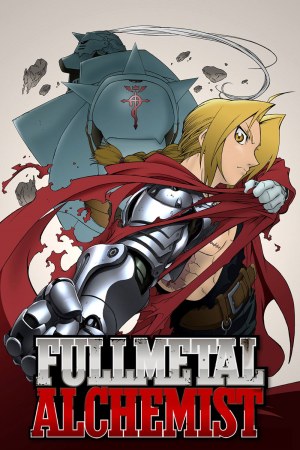
Fullmetal Alchemist

Fullmetal Alchemist

鋼の錬金術師
2003 -2004 Bones MBS 51 episodes Completed
Action Adventure Drama
Details & Synopsis
The year is 1910, approximately. The country is Amestris, approximately. Two boys in a rural town teach themselves alchemy from their absent father's books and decide to do the one thing every alchemical text agrees cannot be done, human transmutation, the resurrection of the dead. Their mother. They are children. They do not survive the attempt intact.
Edward Elric loses his right arm and left leg. Alphonse Elric loses everything, his entire body, seized by the Gate, leaving behind only a soul that Ed binds to a suit of armour in the seconds before he loses consciousness. The exchange is the series' foundation and its recurring nightmare: the law of equivalent exchange, the principle that underpins all alchemy, applied to the thing it was never meant to touch. They paid. They did not get what they paid for.
Produced by Bones and directed by Seiji Mizushima, Fullmetal Alchemist aired on MBS from 2003 to 2004. Fifty-one episodes. It began adapting Hiromu Arakawa's manga faithfully and then, as the weekly production overtook the still-running manga, gradually moved into an original storyline. What followed is one of the most remarkable pivots in anime history: the production team, with Arakawa's blessing and a handful of her discarded plot threads, invented their own story. Their own villain. Their own ending.
The ending they arrived at is darker than Brotherhood's. More ambiguous. More interested in the cost of the boys' choices than in the resolution of the world's politics. Dante. The Gate. What is on the other side of it. A finale that refuses the comfort of restoration and insists that some debts cannot be paid back, they can only be carried forward.
Brotherhood is the manga. Faithful, complete, structurally confident, the story Arakawa intended. This is something else. A parallel history. A what-if that the people who made it took entirely seriously. Both versions are essential. They are not the same show wearing the same premise. They are two writers asking the same question and arriving at different answers about what human beings owe each other and what alchemy, the science of transformation, of making one thing into another, actually costs when the thing being transformed is a person.
Watch both. Then argue about which one broke you worse.
Alt Title 鋼の錬金術師
Studio Bones
Network MBS
Aired 2003 - 2004
Episodes 51
Genre Action, Adventure, Drama
Status Completed

Story & Arc Guide

What Changes Across 51 Episodes

FMA 2003 begins with two brothers looking for a legendary shortcut and gradually turns that search into an argument about what a fair exchange would even mean.

This guide follows the points where the brothers' understanding changes. The database arc names are useful signposts, but the important thing is the question each stretch of episodes leaves them carrying into the next one.

State Alchemist Arc: The Brothers Think Access Is the Answer

Episodes 1–8 · Liore → Central → Tucker

Edward's first plan is straightforward: become a State Alchemist, use the military's resources, find the Philosopher's Stone and restore what he and Al lost.

The first eight episodes immediately start attacking the innocence of that plan.

Liore Teaches Ed That a Fake Miracle Can Still Control Real People

Episodes 1–2 · Cornello and the false Stone

Cornello appears to have exactly what Ed is searching for: a Philosopher's Stone that lets him ignore ordinary alchemical limits. The Stone is fake, but the damage built around it is real.

Lust and Gluttony are already operating behind Cornello, which means the brothers' private search has wandered into somebody else's much larger project before they even know such a project exists.
Why it matters
Liore establishes the trap that will follow Ed for the entire series. The Stone is valuable enough that even the rumor of one can reorganize a city around it.

The State Exam Gives Ed the Key and the Leash

Episodes 5–6 · Mustang gets Ed inside

Mustang engineers Edward's chance to take the State Alchemist exam because he recognizes both Ed's talent and how badly the brothers need access.

The State Alchemist System gives Ed exactly what he wants: archives, contacts and permission to chase research ordinary children could never reach.
What changed
The brothers' quest becomes institutional. From this point on, almost every discovery about the Stone is entangled with the same military that gave Ed the means to search for it.

Nina Turns "Forbidden Research" Into a Person

SPOILER!

Episode 7 · Shou Tucker

Shou Tucker destroys the comfortable idea that State certification separates respectable alchemy from monsters.

Ed has already committed human transmutation, but Tucker shows him another kind of violation: not grief-driven desperation, but treating a person as material because a career depends on producing a result.
Why it matters
Nina becomes the moral wound Ed carries into every later conversation about whether the Philosopher's Stone is worth its price.

The Elrics' Journey: Every Lead Makes the Stone Dirtier

Episodes 9–16 · Youswell → Xenotime → Scar → Ishbal

The brothers travel looking for information, but the important discoveries are increasingly about the State and the people it has already hurt.

Scar Makes the State Alchemist Title Mean Something Else

SPOILER!

Episodes 14–16 · Ishbal enters the story

To Edward, State Alchemist means access. To Scar, it means the people who were sent into Ishbal with alchemy powerful enough to turn military policy into extermination.

Marcoh and Mustang's histories make it impossible for Ed to dismiss Scar's hatred as simple villainy even when Scar is trying to kill him.
What changed
The military stops being merely the annoying institution Ed works for. Its past becomes part of the cost of every privilege the silver watch gives him.

Laboratory 5: The Search Finds the Factory Floor

Episodes 17–25 · Stone ingredients, Homunculi and Hughes

Lab 5 is where the Philosopher's Stone stops being legend and becomes an industrial process somebody has already tried to build.

The Stone Is Not Hidden Treasure. Somebody Has to Make It.

SPOILER!

Episodes 18–22 · prisoners as ingredients

Marcoh's notes lead Edward to the Fifth Laboratory, where prisoners are being collected as raw material for Philosopher's Stone research.

Envy and Lust push Ed toward performing the transmutation himself.
Why it matters
The moral problem changes completely. Ed is no longer asking whether the Stone exists. He is being asked whether getting Al's body back is worth knowingly converting other human beings into the answer.

Alphonse Starts Doubting Whether His Own Childhood Happened

SPOILER!

Episodes 20–24 · Barry finds the weak point

Barry the Chopper realizes the easiest way to hurt Al is not to attack the armor. It is to attack the story holding the soul inside it.

If Ed can bind a soul to armor, Barry asks, how does Al know Ed did not simply create the memories too?
Why it matters
The identity crisis works because Al has no body available to reassure him. The brothers' alchemy has made memory one of the only pieces of evidence Al possesses for his own existence.

Teacher and Greed: Human Transmutation Starts Answering Back

Episodes 27–34 · Izumi, Wrath and Greed

The brothers return to their teacher expecting punishment for breaking her rule. Instead they discover that Izumi has been carrying the same kind of failure.

Wrath Makes Izumi's Loss Walk Into the Room

SPOILER!

Episodes 29–32

The strange child from Yock Island is eventually revealed as Wrath, born from Izumi's attempt to restore her dead baby.

He also carries Edward's original arm and leg after surviving within the Gate.
What changed
Human transmutation is no longer only about the body parts the alchemist lost. The failed result can have a life, anger and agenda of its own.

Greed Proves the Homunculi Are Not One Loyal Machine

SPOILER!

Episodes 30–34

Greed has already broken with the other Homunculi and wants freedom from the system that controls him.

His death gives Edward a crucial piece of information: a Homunculus can be weakened by the remains of the human connected to its creation.
Why it matters
Greed is the first major crack in the idea that the Homunculi all want the same thing. From here on, their individual desires matter as much as the conspiracy using them.

Liore and Ishbal: The Old Massacre Is Being Built Again

Episodes 35–42 · Scar's plan and the military's response

The series returns to Liore with enough context to make the city frightening in a completely new way. A civil conflict is being steered toward the same conditions that once turned Ishbal into a killing field.

Scar Decides the Military Can Become the Ingredient

SPOILER!

Episodes 39–42

Scar's plan for Liore is built around the same horror Edward rejected at Laboratory 5: a Philosopher's Stone requires human lives.

The difference is who Scar intends to sacrifice. He evacuates Liore's civilians and turns the approaching military force into the human cost of the transmutation.
Why it matters
Scar has not escaped the logic he hates. He has reversed it. The State once used Ishbalan lives for alchemical research; Scar answers by making State soldiers the material for his Stone.

Alphonse Becomes the Philosopher's Stone

SPOILER!

Episode 42 · the quest changes bodies

Scar completes the transmutation through Alphonse's armor, turning Al himself into the completed Philosopher's Stone.

The object the brothers have chased since childhood is suddenly no longer something they can find, steal or refuse from a distance.
What changed
The Stone becomes Al. Every faction that wanted the Philosopher's Stone now has a reason to come directly for Edward's brother.

Final Arc: 2003 Reveals the Story It Has Actually Been Telling

Episodes 43–51 · Dante, Sloth, the Gate and the end of Equivalent Exchange

The last nine episodes connect the brothers' childhood mistake, the Homunculi, the Stone and the hidden hand behind repeated conflicts into the 2003 anime's own ending.

Dante Turns the Philosopher's Stone Into a Cycle

SPOILER!

Episodes 44–46

Dante's history with Hohenheim reveals why the Stone keeps appearing around carefully cultivated catastrophes. She has used Philosopher's Stones to move her soul into new bodies and extend her life.

The Homunculi are useful to her because they can create crises, manipulate alchemists and keep the search for another Stone moving.
Why it matters
The conspiracy is not trying to perfect the world. It is built around one person's refusal to accept mortality, which makes Dante an ugly endpoint for the same impulse that started Ed and Al's journey.

Sloth Forces Ed to Destroy the Shape of His Mother

SPOILER!

Episodes 46–47

Sloth is the consequence Ed and Al created when they tried to restore Trisha. Defeating her therefore cannot be separated from admitting that the woman wearing their mother's face is not their mother.
Why it matters
Ed's hardest human-transmutation lesson is not that resurrection failed. It is accepting responsibility for what the failure produced without pretending that destroying Sloth is the same thing as losing Trisha again.

The Gate Breaks Edward's Last Simple Version of Equivalent Exchange

SPOILER!

Episodes 49–51

The final revelations connect alchemy in Amestris to human death and energy on the world beyond the Gate, while Edward and Alphonse each sacrifice themselves trying to restore the other.

The ending does not hand Edward a neat proof that effort always earns an equal reward.
What changed
The boy who began the series treating Equivalent Exchange as a universal guarantee ends it accepting that the world can be unfair and that people still have to act, work and care for one another anyway.